
Supplier Switch
Roof and Loft Windows Installation and Replacement Cost Calculator
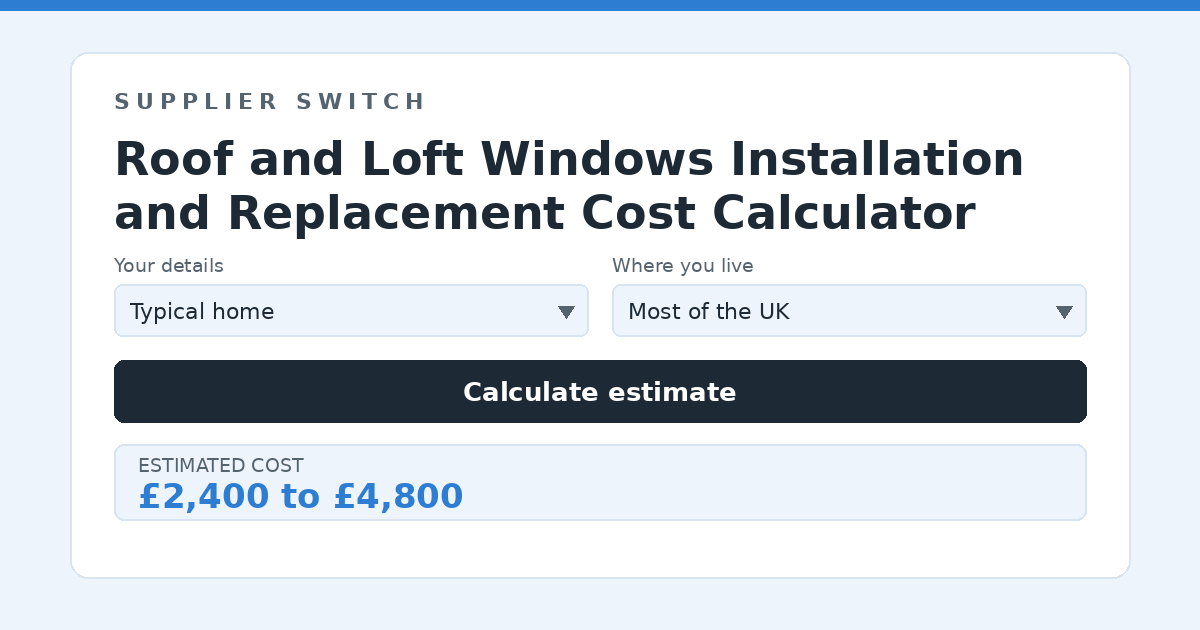
Estimate the cost of installing or replacing windows in a pitched roof or loft space, whether as part of a loft conversion or to bring daylight into an existing room in the roof.
Estimated total cost range
All figures are indicative supply-and-fit ranges based on published UK cost guides. Real quotes vary with site conditions, access and specification – see the explainer and disclaimer below.
How this calculator works
This calculator estimates a realistic price range rather than a single figure, because real-world quotes genuinely vary that much. It starts from typical UK supplied-and-fitted price ranges drawn from published 2026 industry cost guides, then multiplies them by the number of units you enter and by adjustment factors for each choice you make below. The result is a low-to-high band that a fair quote is likely to fall within, not a promise of the exact price you will pay.
A roof or loft window typically costs around to supplied and fitted into an existing pitched roof in 2026, with replacement of an existing unit averaging around because the opening already exists. New openings cost more than swaps, since tiles, battens, felt and sometimes rafters must be cut and trimmed, and larger or higher specification units push towards to .
Number of roof or loft windows
Enter how many roof or loft windows you need. For loft conversions, building regulations set daylight and ventilation requirements, and a habitable loft room normally also needs a suitable escape window, so the number is often determined by the design rather than preference alone.
Window size
Size is one of the biggest cost drivers for any glazed unit. A larger opening needs more frame material and a bigger, heavier sealed glass unit, and it usually takes longer to fit. The calculator uses three broad size bands based on common UK window dimensions: choosing the small band reduces the typical range by around 20 percent, while the large band increases it by around 40 percent. If your windows vary in size, run the calculator once per size band and add the results together.
Operation type
Manual centre-pivot and top-hung windows are the standard choices for lofts, with top-hung designs often preferred at low level because they open clear of headroom and can double as escape windows. Electric and solar operation adds 30 to 40 percent and suits high, hard-to-reach positions. Fixed units are cheapest but cannot contribute to ventilation or escape requirements.
Specification level
Two windows that look similar from the street can sit at very different price points. Budget products use simpler profiles, standard hardware and basic glass. Mid-range covers the typical A-rated units most UK installers quote by default. Premium covers high-end systems with upgraded security hardware, better thermal performance, special finishes or designer profiles, and typically adds around 30 percent to the price.
Where you live
Labour rates are not uniform across the UK. Published cost guides consistently show installation prices in London and the South East running roughly 20 to 30 percent above the national average, driven by higher labour costs, travel, parking and congestion charges. The calculator applies an uplift of around 20 percent if you select London and the South East. Product prices themselves are broadly similar nationwide, so the difference mostly reflects fitting costs.
What else affects the price
The structure of your roof shapes the price more than the window itself. Cut roofs with generous rafter spacing accept standard windows easily, while modern trussed roofs must not have members cut without an engineered solution, which adds design and carpentry costs. Position matters for regulations: in loft conversions, escape windows must meet minimum opening sizes and sill height rules, and any window within reach of a floor may need safety glazing. Most roof windows fall under permitted development, but conservation areas and listed buildings need checking with the local authority first, and flat-profile conservation windows carry a price premium.
Planning permission, building regulations and certification
Most roof glazing falls under permitted development rights, provided the units do not project more than 150 millimetres above the roof plane and sit no higher than the highest part of the roof, but conservation areas, listed buildings and flats have tighter rules, so check with your local planning authority before ordering. Building regulations apply regardless of planning status, covering structural alterations, thermal performance, safety glazing and, in loft conversions, escape and ventilation requirements. Installers registered with a competent person scheme can self-certify that replacement glazing complies with the regulations and issue a certificate you will need when selling the property; for structural roof work, building control involvement is normally required.
Sources
The typical price ranges and guidance used by this calculator draw on the following published resources, which are good starting points for further research: