
Supplier Switch
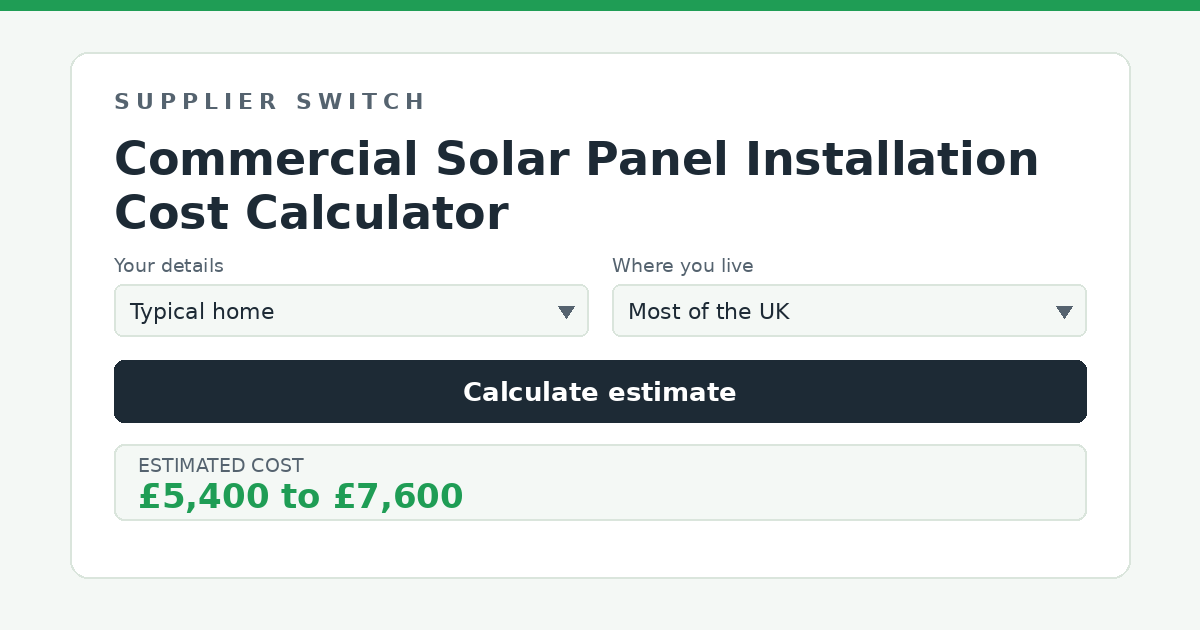
Commercial Solar Panel Installation Cost Calculator
Estimate the cost of a commercial rooftop solar installation for a business premises, from small office systems to warehouse-scale arrays, based on 2026 UK per-kWp pricing.
Estimated installed cost (excluding VAT)
All figures are indicative ranges based on published UK guides and scheme documentation. Real quotes, generation and savings vary – see the explainer and disclaimer below.
How this calculator works
This calculator works in ranges rather than single figures, because real quotes, yields and tariffs genuinely vary that much. It starts from typical UK price, output and savings ranges drawn from published 2026 industry guides and official scheme documentation, then scales them by the quantities you enter and adjusts them for each choice you make below. The result is a low-to-high band that a realistic outcome is likely to fall within, not a promise of the figure you will achieve.
Commercial solar costs roughly to per kWp installed for typical UK rooftop projects in 2026, so a 100 kWp system lands around to excluding VAT. At commercial electricity rates of 20 to 27 pence per kWh, a well used 100 kWp array displaces roughly to of grid electricity a year, putting simple payback at 4 to 7 years before tax treatment.
System size (kWp)
Commercial systems are quoted per kWp, and the per-kWp price falls steeply with scale as fixed costs spread across more capacity: published 2026 figures put small 10 to 30 kWp systems at roughly to per kWp, mid-size 50 to 250 kWp rooftops at to , and large arrays beyond 500 kWp at to . As a sizing guide, a 100 kWp array needs roughly 450 to 600 square metres of unshaded roof and generates around 90,000 to 100,000 kWh per year.
Roof or mounting type
Standing-seam and trapezoidal metal roofs are the quickest and cheapest to mount on. Ballasted systems suit flat roofs with adequate load capacity, ground mounts add framework and groundworks, and pitched tiled roofs cost more per kWp. Fragile, aged or asbestos roofs can add substantial remediation costs that no calculator can anticipate, so a structural survey comes first on older buildings.
Grid connection
Commercial systems above 3.68 kW per phase need G99 approval from the district network operator before connection. On most urban and industrial networks this is routine, but on constrained networks the DNO can require export limitation or network reinforcement, which adds cost and months. A budget uplift of around 15 percent covers typical complications; a formal DNO application is the only way to know for sure.
What else affects the figures
The commercial business case is usually stronger than the domestic one: self-consumption is high because businesses use power exactly when the sun generates it, and the Annual Investment Allowance lets most companies deduct the full cost against profits in year one, effectively returning 19 to 25 percent through corporation tax relief. Costs to watch beyond the array itself include roof condition and remediation, DNO fees and any reinforcement, structural surveys, and battery storage at roughly to per kWh if load shifting is wanted. VAT is charged at 20 percent but is reclaimable for VAT-registered businesses, which is why commercial quotes are conventionally shown excluding VAT.
Certification, planning and grid connection
Commercial rooftop solar often benefits from permitted development rights, but larger arrays, ground mounts, listed buildings and conservation settings can require planning permission, so early advice from the local planning authority is worthwhile. All grid-connected commercial systems need district network operator engagement, routine G98 notification for very small systems and a G99 application, occasionally with export limitation or reinforcement, for anything substantial. A structural assessment of the roof is standard practice, VAT applies at 20 percent but is reclaimable for VAT-registered businesses, and the Annual Investment Allowance typically allows the full cost to be set against year-one profits, which materially improves the investment case.
Sources
The typical prices, yields and scheme details used by this calculator draw on the following published resources, which are good starting points for further research: