
Supplier Switch
Solar Panel Maintenance Cost Calculator
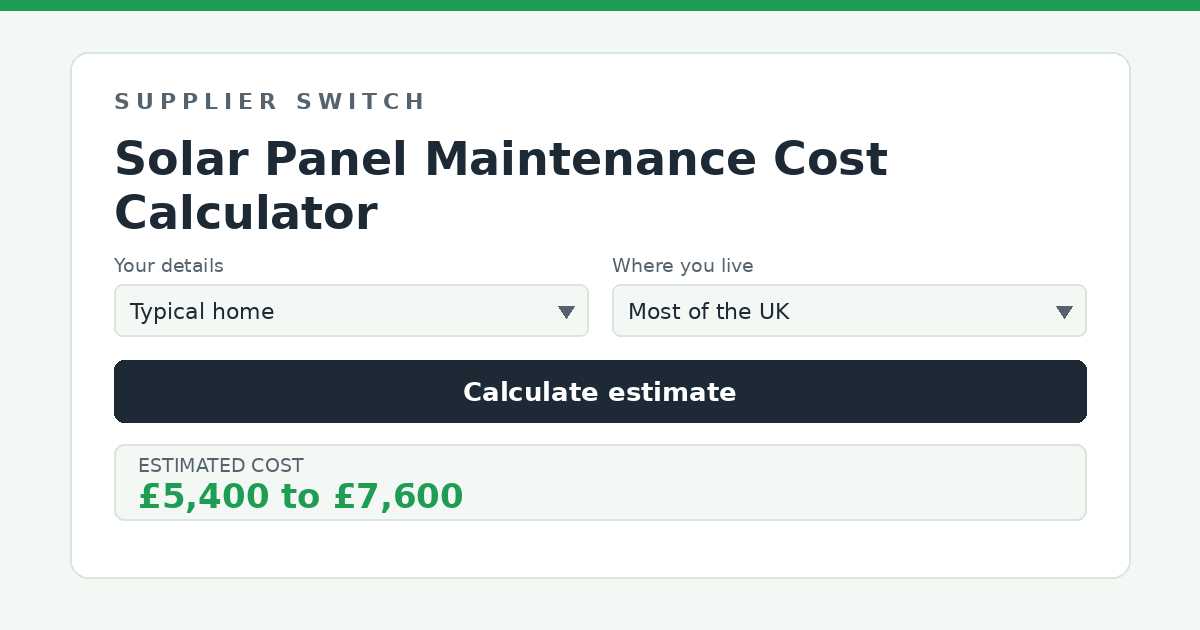
Estimate the realistic annual budget for keeping a solar PV system in good order, covering professional cleaning, periodic servicing and a reserve for inverter replacement.
Estimated annual maintenance budget
All figures are indicative ranges based on published UK guides and scheme documentation. Real quotes, generation and savings vary – see the explainer and disclaimer below.
How this calculator works
This calculator works in ranges rather than single figures, because real quotes, yields and tariffs genuinely vary that much. It starts from typical UK price, output and savings ranges drawn from published 2026 industry guides and official scheme documentation, then scales them by the quantities you enter and adjusts them for each choice you make below. The result is a low-to-high band that a realistic outcome is likely to fall within, not a promise of the figure you will achieve.
Solar panels themselves are close to maintenance-free, with no moving parts and 25 year performance warranties, but the system around them is not quite zero-cost. A sensible annual budget covers occasional professional cleaning at to a visit, a periodic inspection at to , and a reserve for the inverter: string inverters last 10 to 15 years and cost roughly to to replace, which works out at to per year over the system’s life.
Professional cleaning frequency
Dirty panels lose roughly 5 to 15 percent of their output. In most of the UK, rain keeps panels reasonably clean on pitched roofs, and cleaning every one to two years is plenty; homes near busy roads, trees, farmland or the coast may benefit from more frequent visits. A professional clean typically costs to per visit depending on system size and access, and DIY kits for accessible panels cost around to as a one-off.
System inspection frequency
A periodic electrical inspection checks the inverter, isolators, cabling, mounting and generation figures against expectations. Many owners have one every couple of years, or when monitoring shows output dropping. A typical service visit costs to , and some installers bundle monitoring and servicing plans for a monthly fee instead.
Where you live
Installation labour is not priced uniformly across the UK. Published guides put London and South East installation costs roughly 15 to 25 percent above the national average, reflecting labour rates, access and parking. Hardware prices are broadly national, so the difference is mostly in the fitting.
What else affects the figures
Real-world maintenance spend depends heavily on the site. Steep, high or hard-to-reach roofs push cleaning prices up because of access equipment, while ground-mounted and single-storey systems are cheap to keep clean. Bird-proofing mesh, if pigeons discover the warm gap under the panels, is a common one-off at roughly to . Monitoring is the cheapest maintenance of all: checking the generation app monthly catches faults early, and a system generating noticeably below the installer’s predicted output is the trigger to book an inspection rather than waiting for a scheduled visit.
Certification, planning and grid connection
Most home solar installations fall under permitted development and need no planning permission, provided panels do not protrude more than 200 millimetres from the roof plane, though listed buildings and flats have tighter rules and conservation areas restrict panels on walls fronting the highway, so check with your local planning authority if any apply. Use an MCS-certified installer: certification is required to register for Smart Export Guarantee payments and is the industry marker of a compliant installation. Your installer must also notify or seek approval from the district network operator, automatically for systems up to 3.68 kW per phase under G98 and by prior application under G99 above that. Residential solar and battery installations carry 0 percent VAT until 31 March 2027, after which the rate is due to revert to 5 percent.
Sources
The typical prices, yields and scheme details used by this calculator draw on the following published resources, which are good starting points for further research: