
Supplier Switch
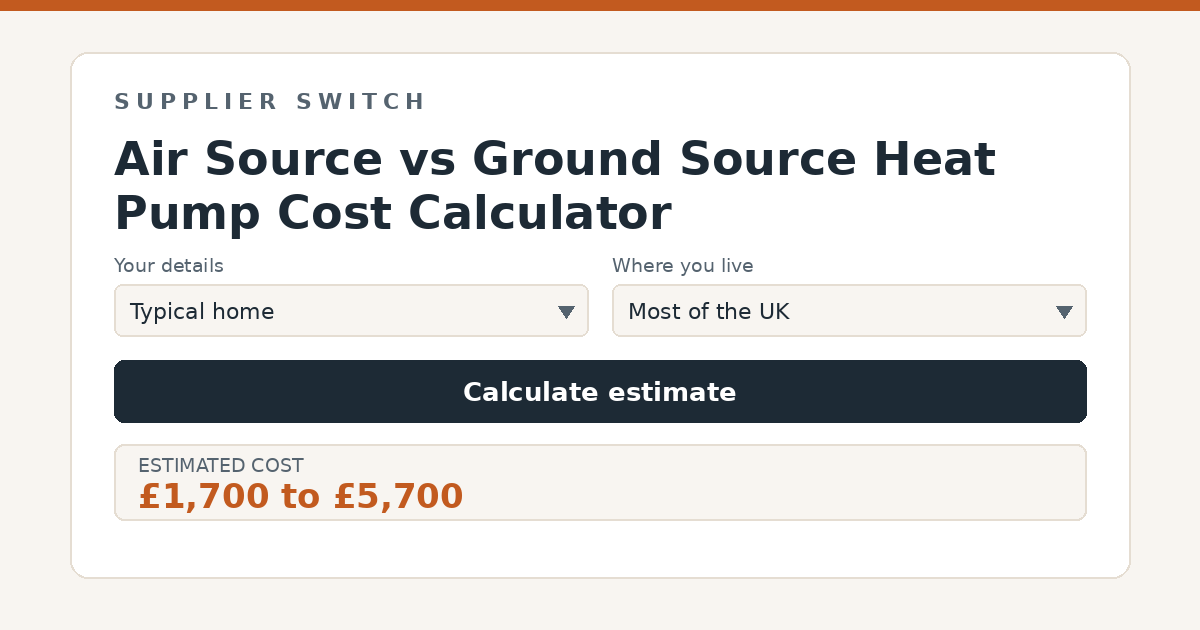
Air Source vs Ground Source Heat Pump Cost Calculator
Compare air source and ground source heat pumps on installation and annual running cost, and see whether the ground source premium earns its keep for your home.
Ground source
Air source
Estimated installation cost difference
Ground source running cost
Air source running cost
Estimated annual running cost difference
All figures are indicative ranges based on published UK guides and scheme documentation. Real quotes, running costs and savings vary – see the explainer and disclaimer below.
How this calculator works
This calculator works in ranges rather than single figures, because real quotes, yields and tariffs genuinely vary that much. It starts from typical UK price, output and savings ranges drawn from published 2026 industry guides and official scheme documentation, then scales them by the quantities you enter and adjusts them for each choice you make below. The result is a low-to-high band that a realistic outcome is likely to fall within, not a promise of the figure you will achieve.
Ground source systems cost roughly to installed against to for air source at the same output, with both receiving the identical Boiler Upgrade Scheme grant, so the ground source premium of roughly to is all groundworks. In return, the stable 8 to 12 degree ground temperature delivers seasonal efficiencies of 380 to 450 percent against air source’s 280 to 400, cutting a typical home’s running cost from to a year to to .
Heat pump size
Heat pumps are sized in kilowatts of heat output, matched to your home’s heat loss rather than its floor area alone: a well insulated three bedroom home might need only 5 kW while a poorly insulated one needs 7.5 kW or more, and the official average UK installation is an 8 kW unit. Larger units cost more, but not proportionally, because design, labour and commissioning costs are similar at any size. An MCS installer must carry out a room-by-room heat loss calculation before quoting, which is the number that actually fixes the size.
Ground collector type
The ground source figure assumes horizontal trench collectors, the cheaper option needing garden area of roughly two to three times the home’s floor area. Vertical boreholes suit compact plots but add 25 to 40 percent for the drilling rig, priced per metre and sensitive to geology, which widens the gap against air source further.
Annual heat demand (kWh)
This is the heat your home needs over a year for space heating and hot water, not the fuel you buy. A typical UK three bedroom house needs roughly 10,000 to 14,000 kWh of heat a year; if you currently heat with gas, your annual gas kWh from your bill multiplied by about 0.85 (boiler efficiency) is a reasonable estimate of heat demand. Well insulated homes sit far lower and large or draughty ones far higher, and every running cost figure on this page scales directly with this number.
Heat pump electricity tariff
The heat pump’s running cost depends heavily on its tariff: standard rates sit around 24.7 to 26.1 pence per kWh under the 2026 caps, while dedicated heat pump and time-of-use tariffs cut the effective rate by a quarter or more through cheap windows and smart scheduling. The comparison system’s fuel is priced at standard rates throughout, so the tariff choice here shows how much of the gap smart tariffs can close or open.
What else affects the figures
The running cost saving of roughly to a year for an average home rarely repays the capital premium within the equipment’s life, which is why air source wins the plain financial comparison for most households; ground source earns its keep where the maths shift, in large homes and high heat demands where the percentage efficiency gap compounds into real money, on rural plots where trenching is cheap, in new builds where groundworks piggyback on construction, and where the silent, invisible operation matters, since ground source has no outdoor fan unit at all. The buried collector should outlast several heat pumps at 50 years or more, which long-horizon owners reasonably count in its favour. Either way, installation quality moves the running costs more than the technology choice, so the same advice applies: MCS certification, a proper heat loss survey and a design SCOP in writing.
Certification, planning and grid connection
Ground source heat pumps generally fall under permitted development for the heat pump itself, but the groundworks deserve early conversations: boreholes and large trench fields can involve environmental permitting depending on location and geology, and listed or conservation settings need planning advice. MCS certification is a condition of the 7,500 pound Boiler Upgrade Scheme grant, which applies to ground source exactly as to air source, and 0 percent VAT applies until March 2027. A ground conditions survey precedes any firm quote, and reinstatement of the garden or drive after trenching is worth confirming in writing.
Sources
The typical prices, yields and scheme details used by this calculator draw on the following published resources, which are good starting points for further research:
- Energy Saving Trust – Ground source heat pumps
- Energy Saving Trust – Air source heat pumps
- GOV.UK – Boiler Upgrade Scheme
- MCS (Microgeneration Certification Scheme)
- Ofgem – Energy price cap
- Checkatrade Cost Guides
- GreenMatch Heat Pump Guides
- Planning Portal – planning permission and building regulations guidance