
Supplier Switch
Heat Pump Running Cost Calculator
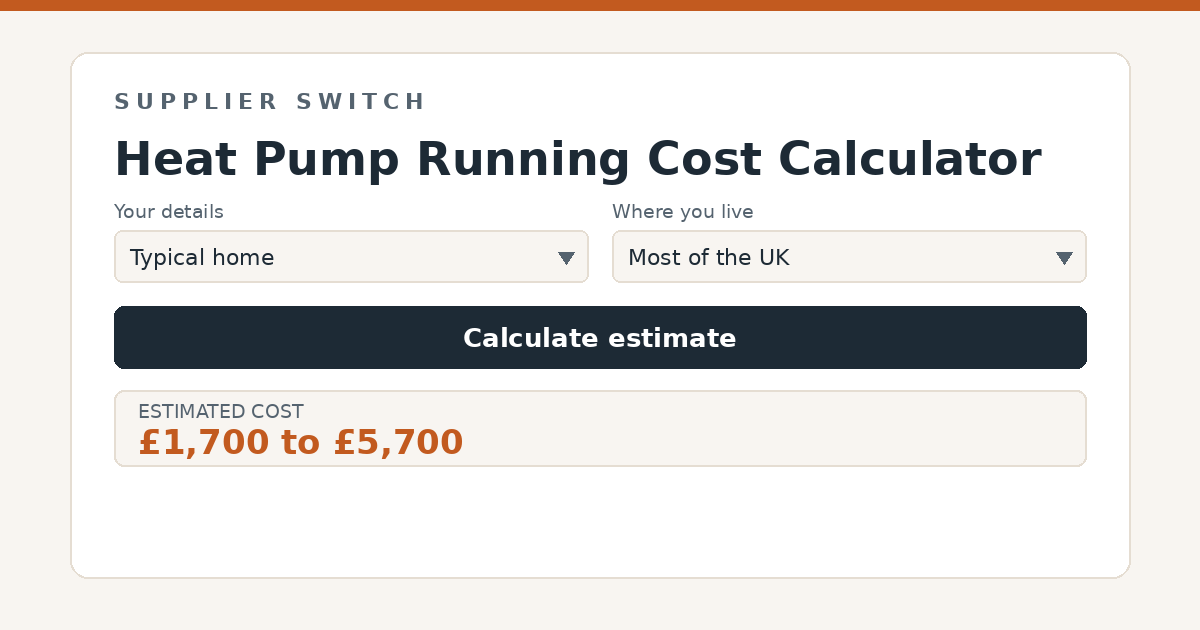
Estimate what a heat pump will cost per year to run, based on your home’s heat demand, the system’s real-world efficiency and your electricity tariff.
Estimated annual running cost
All figures are indicative ranges based on published UK guides and scheme documentation. Real quotes, running costs and savings vary – see the explainer and disclaimer below.
How this calculator works
This calculator works in ranges rather than single figures, because real quotes, yields and tariffs genuinely vary that much. It starts from typical UK price, output and savings ranges drawn from published 2026 industry guides and official scheme documentation, then scales them by the quantities you enter and adjusts them for each choice you make below. The result is a low-to-high band that a realistic outcome is likely to fall within, not a promise of the figure you will achieve.
A well installed air source heat pump in a typical UK home costs roughly to a year to run at 2026 electricity prices, with ground source systems nearer to thanks to their higher efficiency. For comparison, heating the same home with a gas boiler costs a broadly similar amount at current price cap rates, while direct electric heating costs two and a half to three times as much, which is why the heat pump conversation is mostly about upfront cost and installation quality rather than running cost risk.
Annual heat demand (kWh)
This is the heat your home needs over a year for space heating and hot water, not the fuel you buy. A typical UK three bedroom house needs roughly 10,000 to 14,000 kWh of heat a year; if you currently heat with gas, your annual gas kWh from your bill multiplied by about 0.85 (boiler efficiency) is a reasonable estimate of heat demand. Well insulated homes sit far lower and large or draughty ones far higher, and every running cost figure on this page scales directly with this number.
System efficiency (SCOP)
SCOP, the seasonal coefficient of performance, is how much heat the system delivers per unit of electricity across a whole year: at SCOP 3.5, every kWh of electricity becomes 3.5 kWh of heat. Design quality drives it more than the hardware brand: low flow temperatures, correctly sized radiators and sensible controls routinely achieve 3.5 to 4.0 or better, while rushed installations running hot flow temperatures languish at 2.5 to 3.0 and cost 30 to 40 percent more to run. This single number is why installer quality matters more than any other purchasing decision.
Electricity tariff
Standard tariffs sit around 24.7 to 26.1 pence per kWh under the 2026 price caps, but dedicated heat pump and time-of-use tariffs cut the effective rate substantially, through cheap overnight windows, heat pump specific rates or smart control that shifts running into cheap periods. Published guides put annual running costs at to on a standard tariff for a typical home, falling to to on an optimised tariff, so the tariff decision is worth several hundred pounds a year for zero capital outlay.
What else affects the figures
Running cost is heat demand divided by SCOP times the electricity price, and each lever matters: insulation and draught-proofing cut the demand, design quality sets the SCOP, and the tariff sets the price. Weather compensation controls, which lower the flow temperature whenever the outside air allows, are the cheapest efficiency upgrade going and often already fitted but not enabled. Real bills also swing with the winter itself, plus or minus 15 percent between mild and harsh years, and with habits, since heat pumps run most efficiently held at a steady temperature rather than blasted on and off like a boiler. If a system seems expensive to run, a SCOP check against the design estimate identifies whether the problem is the installation or the expectation.
Certification, planning and grid connection
If a calculation here prompts a project, the practical next step is an MCS-certified installer’s survey: MCS installers must carry out a room-by-room heat loss calculation to the industry standard before quoting, which turns the broad ranges on this page into a design for your actual home, and MCS certification is a condition of the Boiler Upgrade Scheme grant. Most domestic heat pump installations fall under permitted development subject to siting and noise rules, with the usual exceptions for listed buildings and conservation areas, and 0 percent VAT applies to residential installations until March 2027.
Sources
The typical prices, yields and scheme details used by this calculator draw on the following published resources, which are good starting points for further research: