Supplier Switch
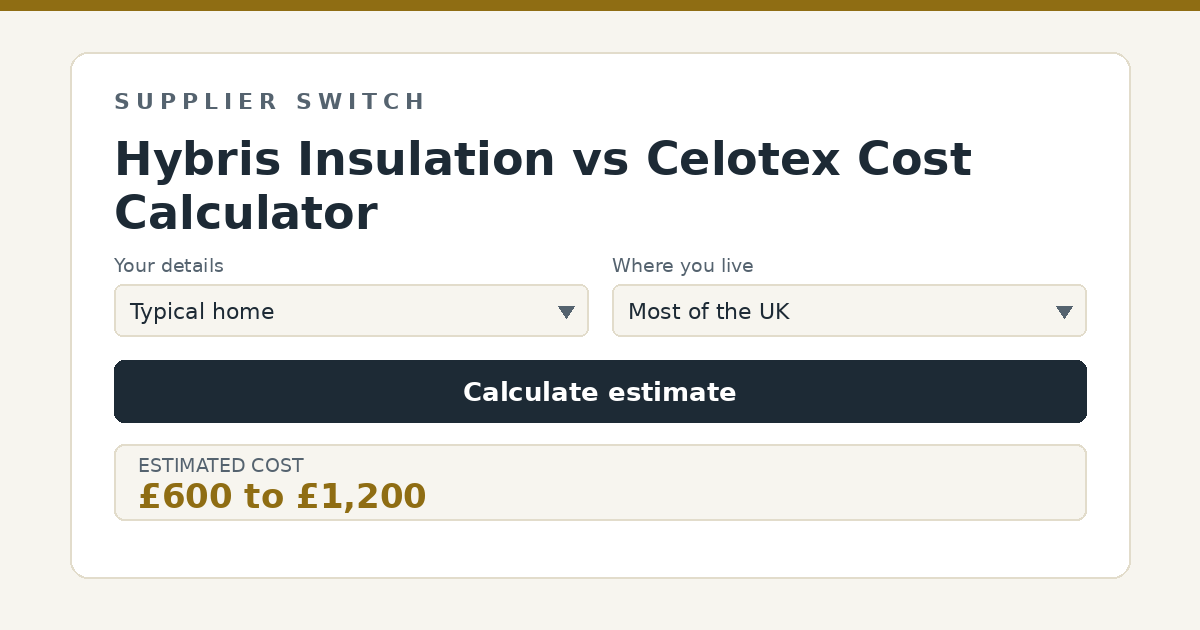
Hybris Insulation vs Celotex Cost Calculator
Compare ACTIS Hybris honeycomb insulation panels against Celotex PIR boards on cost, the two contenders for many roof and timber frame jobs.
ACTIS Hybris panels
Celotex PIR board
Estimated cost difference
All figures are indicative ranges based on published UK guides and scheme documentation. Real quotes, running costs and savings vary – see the explainer and disclaimer below.
How this calculator works
This calculator works in ranges rather than single figures, because real quotes, yields and tariffs genuinely vary that much. It starts from typical UK price, output and savings ranges drawn from published 2026 industry guides and official scheme documentation, then scales them by the quantities you enter and adjusts them for each choice you make below. The result is a low-to-high band that a realistic outcome is likely to fall within, not a promise of the figure you will achieve.
Hybris and Celotex-class PIR sit remarkably close on price, both roughly to per square metre at comparable 100 mm class thicknesses in 2026, so the choice is rarely settled by cost alone. They are different animals: Hybris is a lightweight honeycomb of reflective films and foam that works partly through radiant barriers and relies on adjacent air gaps for its full certified performance, while Celotex is dense rigid PIR foam whose performance is intrinsic to the board.
Area to insulate (square metres)
Enter the area to be covered in the material. Both options are priced per square metre for the same area so the totals compare directly; allow around 10 percent extra for cuts and waste when ordering boards, and check coverage per pack for rolls and quilts.
Board thickness
Rigid insulation is priced largely by volume, so thickness moves the per square metre cost almost linearly: 50 mm boards cost roughly 60 percent of the 100 mm price and 150 mm around 40 percent more. The thickness you need depends on the U-value target for the element under Building Regulations Approved Document L and the material’s thermal conductivity, which is why higher-performing boards can hit the same target with less depth.
What else affects the figures
The practical differences decide most projects: Hybris is dramatically lighter, cuts with a knife, squeezes between irregular rafters and studs without the precise sawing PIR demands, and installs noticeably faster overhead, which is why roofers and timber frame builders like it; PIR delivers more insulation per millimetre of build-up when the air gaps Hybris needs are counted, suits flat solid substrates, and its foil faces double as the vapour control layer. Certification is the thing to check rather than argue about in either direction, since both carry BBA or equivalent certificates specifying the exact build-ups their claimed performance requires, and both disappoint when installed outside those details. Since supply prices genuinely overlap, the deciding costs are usually labour speed for Hybris versus thinner build-ups for PIR.
Certification, planning and grid connection
If a calculation here prompts a project, Building Regulations Approved Document L is the standard the work should meet, with U-value targets for each element, and installers registered with TrustMark or a competent person scheme can self-certify compliance. Check grant eligibility before paying for anything: ECO4 runs to 31 December 2026 and the Great British Insulation Scheme continues alongside it, both funding measures partly or fully for qualifying households, and domestic insulation carries 0 percent VAT until 31 March 2027 in any case. An EPC assessment before and after larger projects evidences the improvement for future buyers and lenders.
Sources
The typical prices, yields and scheme details used by this calculator draw on the following published resources, which are good starting points for further research: