
Supplier Switch
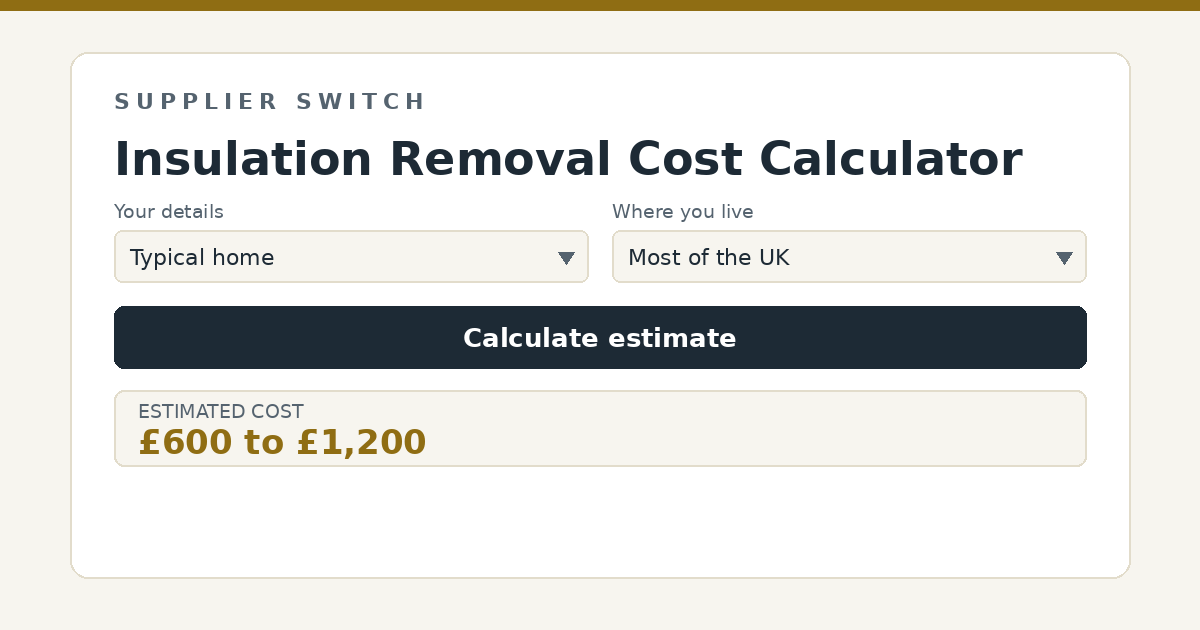
Insulation Removal Cost Calculator
Estimate the cost of removing old, damp, contaminated or problematic insulation, including spray foam removal and cavity wall extraction, before replacement or remediation.
Estimated removal cost
All figures are indicative ranges based on published UK guides and scheme documentation. Real quotes, running costs and savings vary – see the explainer and disclaimer below.
How this calculator works
This calculator works in ranges rather than single figures, because real quotes, yields and tariffs genuinely vary that much. It starts from typical UK price, output and savings ranges drawn from published 2026 industry guides and official scheme documentation, then scales them by the quantities you enter and adjusts them for each choice you make below. The result is a low-to-high band that a realistic outcome is likely to fall within, not a promise of the figure you will achieve.
Removing a typical loft’s old insulation costs to in 2026 including disposal, cavity wall extraction for a semi runs to , and spray foam removal, the fastest-growing category, typically costs to for a loft depending on foam type and how it was applied. Removal jobs exist for good reasons: vermin or water contamination, failed damp cavity fill, historic materials, or spray foam blocking a mortgage or survey.
Area to insulate (square metres)
Enter the area the material covers: the loft floor area for loft insulation, the roof slope area for spray foam applied under the tiles, or the external wall area for cavity extraction. A typical semi has a 40 to 55 square metre loft and around 80 square metres of cavity wall.
What is being removed
Old loft wool is bagged and vacuumed out at roughly to per square metre. Cavity extraction uses suction through drilled holes to clear failed or damp fill at around to per square metre. Spray foam removal is the expensive one at to per square metre, since cured foam must be laboriously cut and scraped from timbers, and where it was applied directly to the underside of tiles and felt, full removal without damage is slow, careful work.
Where you live
Installation labour is not priced uniformly across the UK, with published guides putting London and South East insulation quotes roughly 15 to 25 percent above the national average. Materials are broadly national in price, so the difference sits mostly in labour, access and parking.
What else affects the figures
Spray foam removal deserves its own caution: several major lenders flag properties with foam on the roof timbers, and a wave of removal firms has followed, some as questionable as the installers that preceded them, so insist on a clear scope covering full removal versus partial, timber inspection afterwards and photographic evidence, and get the roof checked while it is exposed. Cavity extraction should end with a borescope confirmation that the cavity is genuinely clear, since partial extraction before refilling causes cold spots. Old loft insulation can sometimes simply be topped over rather than removed if it is dry and clean, saving the whole cost, and any removal involving suspected asbestos-containing materials in older lofts moves into licensed territory with different pricing entirely.
Certification, planning and grid connection
Spray foam sits in a category of its own for due diligence. Several major mortgage lenders flag properties with foam on the roof timbers, RICS guidance urges caution, and ECO4 excludes spray foam from funding, so before any application get the product’s BBA certificate, a written specification confirming application to a membrane rather than directly to tiles or felt, and keep every document for future buyers and surveyors. Removal, if a sale or remortgage demands it, is slow manual work priced accordingly. Building Regulations ventilation and condensation requirements apply as with any roof insulation, and unrelated to foam, any pre-1980s loft materials suspected of containing asbestos need licensed assessment before disturbance.
Sources
The typical prices, yields and scheme details used by this calculator draw on the following published resources, which are good starting points for further research: