
Supplier Switch
Polystyrene Insulation Cost Calculator
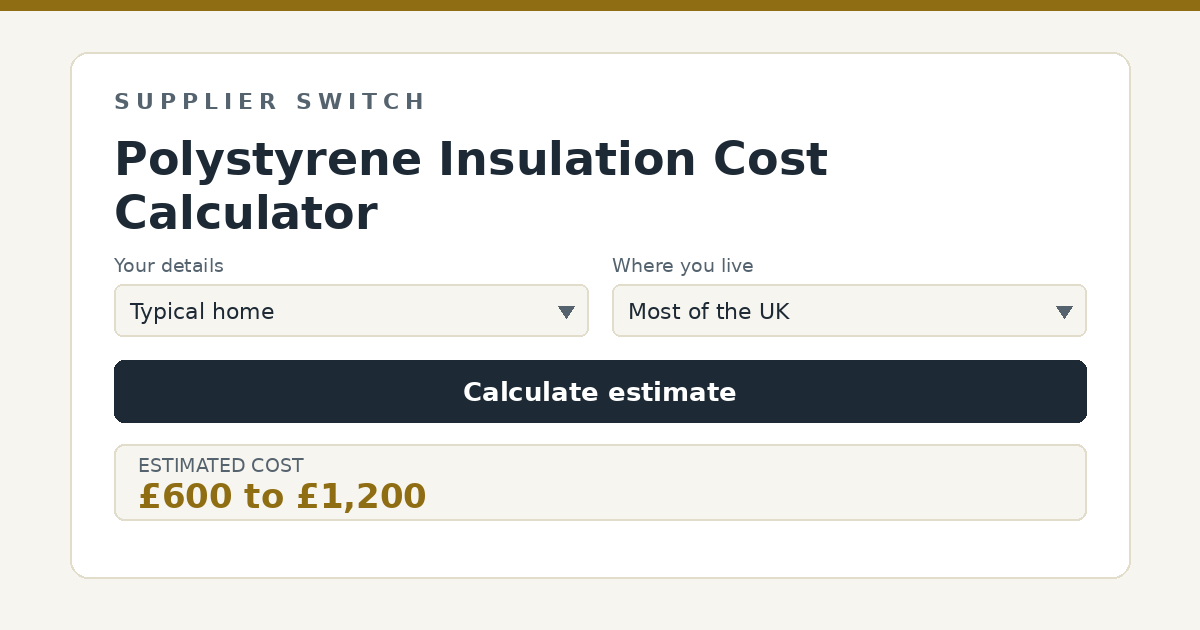
Estimate the cost of polystyrene insulation, EPS boards and bead systems, the budget workhorse behind external wall systems, floors and cavity fills.
Estimated cost
All figures are indicative ranges based on published UK guides and scheme documentation. Real quotes, running costs and savings vary – see the explainer and disclaimer below.
How this calculator works
This calculator works in ranges rather than single figures, because real quotes, yields and tariffs genuinely vary that much. It starts from typical UK price, output and savings ranges drawn from published 2026 industry guides and official scheme documentation, then scales them by the quantities you enter and adjusts them for each choice you make below. The result is a low-to-high band that a realistic outcome is likely to fall within, not a promise of the figure you will achieve.
EPS board costs roughly to per square metre at 100 mm supply-only in 2026, the cheapest rigid insulation available, with bonded bead cavity fill installed at roughly to per square metre of wall. Expanded polystyrene’s conductivity of 0.030 to 0.038 W/mK is weaker than PIR, so it needs around 30 to 50 percent more thickness for the same performance, but where space allows, its price per unit of insulation is hard to beat, which is why EPS underpins most external wall insulation systems and ground floor build-ups.
Area to insulate (square metres)
Enter the area to be covered. EPS comes in standard sheet sizes similar to other boards, and as loose bonded beads for cavity injection, where the wall area drives the quantity.
Board thickness
Rigid insulation is priced largely by volume, so thickness moves the per square metre cost almost linearly: 50 mm boards cost roughly 60 percent of the 100 mm price and 150 mm around 40 percent more. The thickness you need depends on the U-value target for the element under Building Regulations Approved Document L and the material’s thermal conductivity, which is why higher-performing boards can hit the same target with less depth.
Product and installation
White EPS board is among the cheapest insulation per square metre to buy, with fitted prices reflecting the same labour as any board work. Bonded bead is EPS in injected form, blown into wall cavities with adhesive at an installed price per square metre of wall, flowing better than wool through narrow or awkward cavities. Grey graphite-enhanced EPS performs around 20 percent better thermally for a modest premium and dominates external wall insulation systems.
What else affects the figures
EPS’s qualities suit specific jobs: it is moisture-tolerant and vapour-open enough for external wall systems and floors, dimensionally stable, and easy to cut, while its compressive strength in standard grades is below XPS, keeping XPS the choice for heavy-load floors and below-ground work. Fire behaviour is the property to specify carefully: EPS is combustible and is always used behind protective finishes, render, screed or board, with fire barriers where systems require them, and reputable system installations handle this by design. The graphite grey variants deserve consideration in any space-constrained EPS application, closing most of the performance gap to PIR at well under PIR money.
Certification, planning and grid connection
If a calculation here prompts a project, Building Regulations Approved Document L is the standard the work should meet, with U-value targets for each element, and installers registered with TrustMark or a competent person scheme can self-certify compliance. Check grant eligibility before paying for anything: ECO4 runs to 31 December 2026 and the Great British Insulation Scheme continues alongside it, both funding measures partly or fully for qualifying households, and domestic insulation carries 0 percent VAT until 31 March 2027 in any case. An EPC assessment before and after larger projects evidences the improvement for future buyers and lenders.
Sources
The typical prices, yields and scheme details used by this calculator draw on the following published resources, which are good starting points for further research: