
Supplier Switch
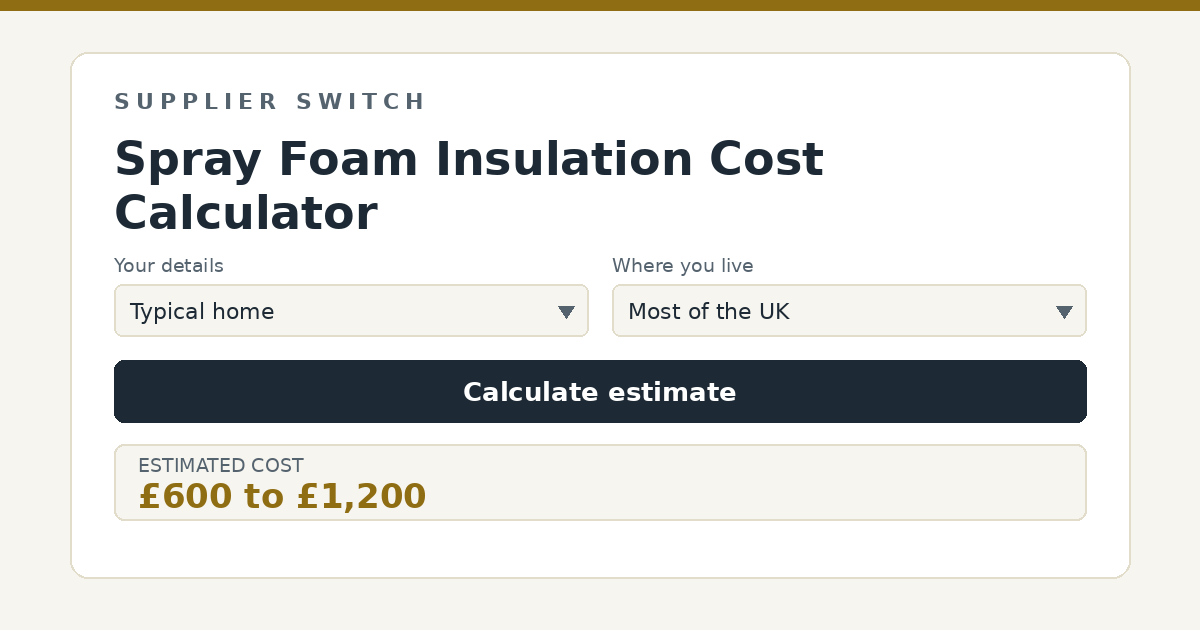
Spray Foam Insulation Cost Calculator
Estimate the cost of professionally applied spray foam insulation, with an honest account of the mortgage and survey issues every UK homeowner should weigh first.
Estimated installed cost
All figures are indicative ranges based on published UK guides and scheme documentation. Real quotes, running costs and savings vary – see the explainer and disclaimer below.
How this calculator works
This calculator works in ranges rather than single figures, because real quotes, yields and tariffs genuinely vary that much. It starts from typical UK price, output and savings ranges drawn from published 2026 industry guides and official scheme documentation, then scales them by the quantities you enter and adjusts them for each choice you make below. The result is a low-to-high band that a realistic outcome is likely to fall within, not a promise of the figure you will achieve.
Professional spray foam costs roughly to per square metre applied in 2026, putting a typical three bedroom semi’s roof at to . The product’s genuine strengths are speed, a loft sprays in one to two days, air-tightness and reach into irregular spaces that boards and rolls cannot seal.
Area to insulate (square metres)
Enter the area to be sprayed, usually the roof slope area for underside-of-roof applications, which is larger than the loft floor: a typical semi’s roof slopes total 60 to 90 square metres. For floors or walls, measure the surface being treated.
Foam type
Open cell foam is softer, vapour-open and cheaper, and is the usual choice for roof underside applications where breathability matters. Closed cell foam is denser, adds rigidity and resists moisture, costing around 40 to 50 percent more, and is favoured for floors and some commercial uses. Lender attitudes differ between the two, with closed cell generally viewed more cautiously on roofs, so the choice affects saleability as well as performance.
Where you live
Installation labour is not priced uniformly across the UK, with published guides putting London and South East insulation quotes roughly 15 to 25 percent above the national average. Materials are broadly national in price, so the difference sits mostly in labour, access and parking.
What else affects the figures
The caveat that now dominates this market is mortgageability: several major UK lenders, including some of the largest, flag properties with spray foam on the roof timbers, because cured foam conceals the timber condition a surveyor needs to inspect, and RICS guidance reflects the same concern; sales and remortgages are regularly delayed or declined until foam is removed at to . If you proceed, the risk is managed rather than eliminated by using a BBA-certified product applied to a membrane rather than directly to tiles, an installer who provides the full certification and specification paperwork, and by keeping every document for future buyers. It is also worth knowing that spray foam is excluded from ECO4 funding, and that for most standard lofts, mineral wool at a third of the price achieves the Building Regulations target without any of the lending friction, which is why our honest guidance is to treat spray foam as a specialist product for specific problems rather than a default.
Certification, planning and grid connection
Spray foam sits in a category of its own for due diligence. Several major mortgage lenders flag properties with foam on the roof timbers, RICS guidance urges caution, and ECO4 excludes spray foam from funding, so before any application get the product’s BBA certificate, a written specification confirming application to a membrane rather than directly to tiles or felt, and keep every document for future buyers and surveyors. Removal, if a sale or remortgage demands it, is slow manual work priced accordingly. Building Regulations ventilation and condensation requirements apply as with any roof insulation, and unrelated to foam, any pre-1980s loft materials suspected of containing asbestos need licensed assessment before disturbance.
Sources
The typical prices, yields and scheme details used by this calculator draw on the following published resources, which are good starting points for further research: