Supplier Switch
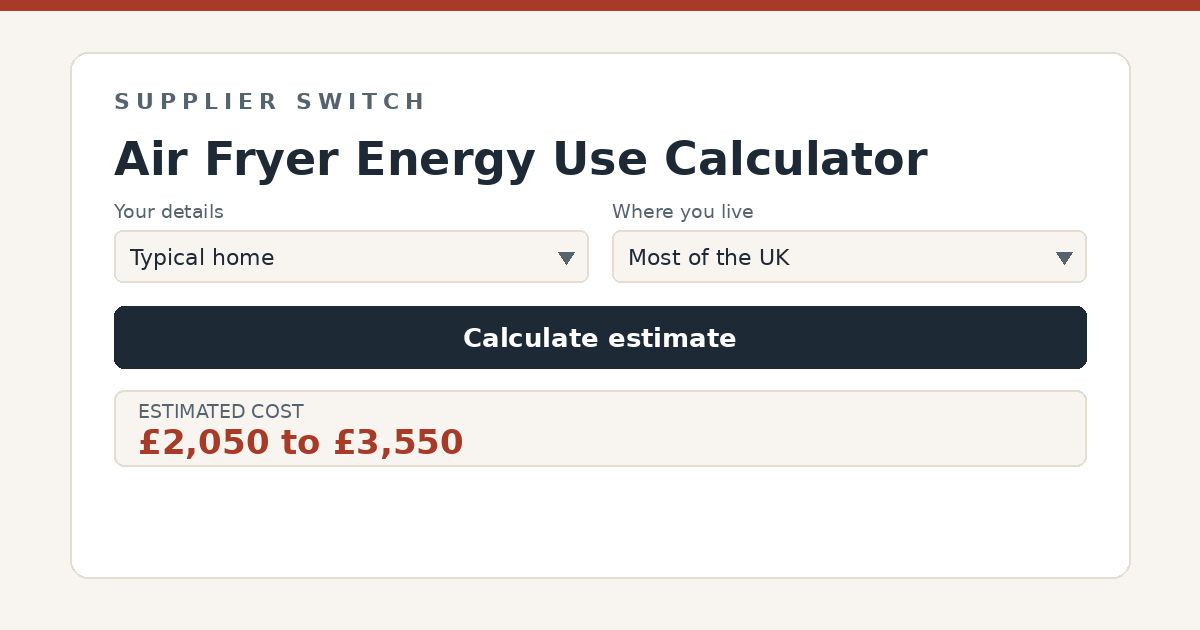
Air Fryer Energy Use Calculator
Estimate what your air fryer costs to run per year at 2026 electricity prices, and how it compares with cooking the same meals in an electric oven.
Estimated annual air fryer cost
Electric oven (same meals)
Air fryer
Estimated annual saving with the air fryer
All figures are indicative ranges based on published UK guides and scheme documentation. Real quotes, running costs and savings vary – see the explainer and disclaimer below.
How this calculator works
This calculator works in ranges rather than single figures, because real quotes, yields and tariffs genuinely vary that much. It starts from typical UK price, output and savings ranges drawn from published 2026 industry guides and official scheme documentation, then scales them by the quantities you enter and adjusts them for each choice you make below. The result is a low-to-high band that a realistic outcome is likely to fall within, not a promise of the figure you will achieve.
A standard air fryer used four times a week costs roughly to a year to run at 2026 electricity prices of 24.7 to 26.1 pence per kWh, using about 0.5 to 0.8 kWh per half-hour session against roughly 1.5 to 2.5 kWh for an electric oven cooking the same meal with its preheat. The saving comes from physics rather than marketing: a small cavity heats in two or three minutes and concentrates hot air on the food, while an oven spends its first fifteen minutes and much of its energy heating itself and the air around your dinner.
Uses per week
Count typical cooking sessions per week: many households run the air fryer four to seven times weekly once it earns its counter space, and heavy users considerably more. The calculator annualises whatever you enter across 52 weeks, so a realistic weekly habit gives the most honest yearly figure.
Typical session length
Session length scales the energy for both the air fryer and the oven comparison, since longer cooking means more element time in either appliance. Air fryers cycle their element rather than running it flat out once up to temperature, which the underlying figures reflect: a 30 minute session in a standard air fryer uses roughly 0.5 to 0.8 kWh, not the full nameplate rating for the whole half hour.
Air fryer size
Bigger baskets carry bigger elements: compact single-drawer models run around 1000 watts, the popular family sizes 1400 to 1700, and large dual-drawer machines up to 2400. A larger machine uses more energy per session but often replaces two cooking processes at once, so cost per meal can still fall, and cooking one portion in a huge dual-zone machine is where the efficiency story quietly leaks.
What else affects the figures
The honest caveats keep the story credible: an air fryer saves versus an electric oven, while gas ovens cook at gas prices and narrow the gap considerably; batch cooking a full oven of food for a family can beat multiple air fryer rounds; and the appliance saves nothing sitting unused, so the payback on a to machine flows from genuinely displaced oven sessions, typically within a year or two for regular users. Microwave, air fryer and oven form a sensible hierarchy, with the microwave still cheapest for reheating, the air fryer for crisping and small-to-medium cooking, and the oven for volume. If your tariff has cheap windows, none of these appliances cares when it runs, which makes daytime cooking on a time-of-use tariff one more small lever.
Certification, planning and grid connection
Appliance running costs move with the Ofgem price cap, so every figure here shifts a little each quarter, and time-of-use tariffs increasingly reward shifting flexible usage into cheap windows, which suits appliances that do not care when they run. Energy labels remain the quickest like-for-like efficiency comparison when buying, and for fixed installations such as air conditioning, F-Gas certified installation is a legal requirement while permitted development rules govern outdoor condenser placement, with listed buildings and conservation areas needing consent. Nothing on this page requires planning permission or building control in normal domestic use.
Sources
The typical prices, yields and scheme details used by this calculator draw on the following published resources, which are good starting points for further research: