
Supplier Switch
Condensing Boiler vs Combi Cost Calculator
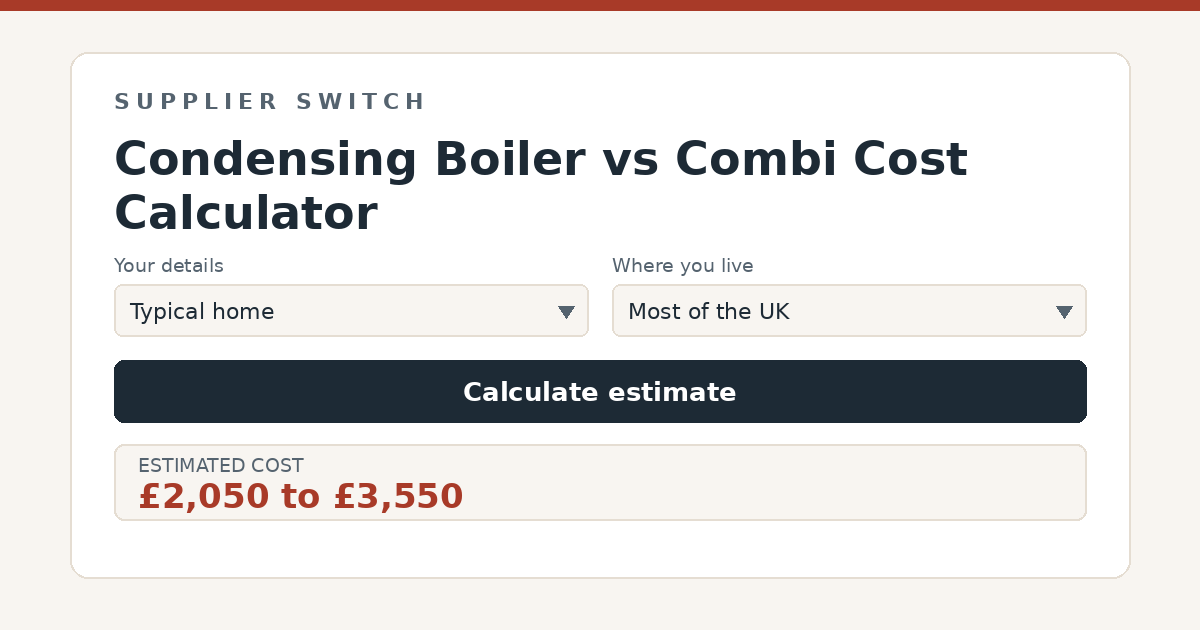
Compare a conventional condensing boiler system against a condensing combi on installation and running cost, untangling the terminology trap in this popular comparison.
Heat-only condensing boiler
Condensing combi
Estimated installation cost difference
Heat-only system running cost
Combi running cost
Estimated annual running cost difference
All figures are indicative ranges based on published UK guides and scheme documentation. Real quotes, running costs and savings vary – see the explainer and disclaimer below.
How this calculator works
This calculator works in ranges rather than single figures, because real quotes, yields and tariffs genuinely vary that much. It starts from typical UK price, output and savings ranges drawn from published 2026 industry guides and official scheme documentation, then scales them by the quantities you enter and adjusts them for each choice you make below. The result is a low-to-high band that a realistic outcome is likely to fall within, not a promise of the figure you will achieve.
First, the terminology trap this comparison usually hides: condensing is not a boiler type but an efficiency technology that every gas boiler sold since 2005 must have, so the real comparison is between a heat-only or system condensing boiler with its cylinder and tanks, at to replaced like-for-like, and a condensing combi at to . Running costs sit within touching distance, both above 90 percent efficient, with the tanked system paying only its cylinder’s standing losses of roughly to a year.
Home size
Home size scales the installation estimates: larger homes need higher output units, bigger cylinders where fitted and sometimes more pipework, while flats and small houses sit below the three bedroom baseline that published guide prices describe. It does not scale the running cost figures, which follow the demand number you enter instead.
Annual heat demand (kWh)
This is the heat your home needs over a year for space heating and hot water. A typical UK three bedroom house needs roughly 10,000 to 14,000 kWh; if you heat with gas today, your annual gas kWh from your bill multiplied by about 0.85 for boiler efficiency is a good estimate. Every running cost figure on this page scales directly with this number.
Boiler brand tier
Brand moves a quote by several hundred pounds either way: budget boilers do the same job with shorter warranties of around 2 to 5 years, mid-range brands balance price against 5 to 10 year cover, and the premium names, led by Worcester Bosch and Vaillant, cost 15 to 25 percent more for industry-leading reliability records and warranties up to 12 years. Over a 10 to 15 year boiler life, a long parts-and-labour warranty is worth real money, which is why premium brands hold their price.
Where you live
Heating labour is not priced uniformly across the UK, with published guides putting London and South East installation quotes roughly 15 to 25 percent above the national average. The hardware costs the same everywhere, so the difference sits in engineer day rates, access and parking.
What else affects the figures
If you arrived here comparing an old non-condensing boiler against a new combi, the answer is happier: any modern replacement, combi or otherwise, lifts efficiency from 60 to 80 percent to over 90, worth up to a few hundred pounds a year for a typical home, and the configuration choice rides on hot water behaviour rather than efficiency. Keeping a heat-only setup makes sense where the cylinder serves multiple bathrooms, where an older open-vented system would be expensive to re-plumb, or where low mains pressure would starve a combi; converting to combi costs to on top of the boiler and repays in space, simplicity and slightly lower running costs. Whichever way, condensing efficiency is only delivered when the system runs cool enough to condense, so a flow temperature turned down to 60 degrees Celsius or lower is the free upgrade either configuration deserves.
Certification, planning and grid connection
Every gas boiler installation, repair or removal is legally restricted to Gas Safe registered engineers, and working on gas without registration is a criminal offence, so checking the engineer’s Gas Safe ID card and registration number is the non-negotiable first step. The installation is notifiable under Building Regulations, which registered installers self-certify, and Boiler Plus rules require time and temperature controls plus an efficiency measure on new combi installations. Flue positions and condensate drainage follow set standards worth confirming in the quote, an annual service protects both safety and the manufacturer warranty, and a carbon monoxide alarm near the boiler is cheap, sensible and in rented properties legally required.
Sources
The typical prices, yields and scheme details used by this calculator draw on the following published resources, which are good starting points for further research: