
Supplier Switch
Immersion Heater Installation Cost Calculator
Estimate the cost of replacing or installing an immersion heater, the electric element in a hot water cylinder that heats water directly or backs up the boiler.
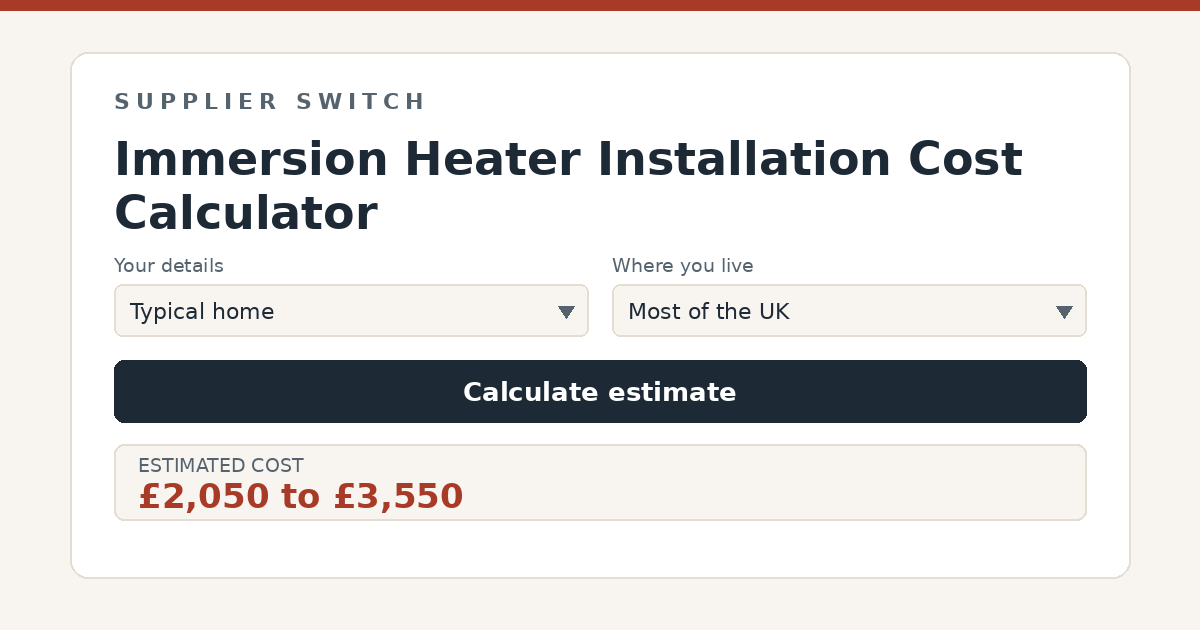
Estimated installed cost
All figures are indicative ranges based on published UK guides and scheme documentation. Real quotes, running costs and savings vary – see the explainer and disclaimer below.
How this calculator works
This calculator works in ranges rather than single figures, because real quotes, yields and tariffs genuinely vary that much. It starts from typical UK price, output and savings ranges drawn from published 2026 industry guides and official scheme documentation, then scales them by the quantities you enter and adjusts them for each choice you make below. The result is a low-to-high band that a realistic outcome is likely to fall within, not a promise of the figure you will achieve.
Replacing an immersion heater element costs to in 2026 including the part, drain-down and labour, with new wiring or switches adding more, one of the smaller jobs in home heating but one worth doing promptly since a failed immersion often trips the whole circuit. The immersion’s roles are backup hot water when the boiler fails, sole water heating in some all-electric homes, and increasingly the destination for cheap overnight or surplus solar electricity.
Job type
Replacing a failed element in an existing cylinder is a one to two hour job: drain down enough water, swap the element, refill and test. Fitting an immersion where none existed, or where the old wiring is unsafe, adds a dedicated circuit, a double pole switch and an electrician’s time, roughly to on top. Elements themselves are cheap at to ; the labour and access are the price.
Timer or smart control
An immersion run raw on a peak-rate supply is the most expensive hot water in Britain, so control is where the value hides: a simple timer at to fitted confines heating to off-peak windows on Economy 7 style tariffs, and smart controls or solar diverters go further, heating water only with cheap or surplus power. For any household using the immersion regularly, the control pays for itself inside a year.
Where you live
Heating labour is not priced uniformly across the UK, with published guides putting London and South East installation quotes roughly 15 to 25 percent above the national average. The hardware costs the same everywhere, so the difference sits in engineer day rates, access and parking.
What else affects the figures
Running cost is the immersion’s defining feature: at 24.7 to 26.1 pence per kWh on a standard tariff it heats water at roughly four times the cost of a gas boiler, so households with gas should treat it strictly as backup, while all-electric households should pair it with an off-peak tariff and a well insulated cylinder, dropping the effective rate by half or more. A thermostat set around 60 to 65 degrees Celsius balances legionella safety against scale and waste, and a failed thermostat is a common, cheap fix worth trying before condemning the element. In hard water areas elements scale up and fail faster, making titanium or incoloy elements worth their small premium, and any new wiring is notifiable electrical work for a qualified electrician rather than a DIY afternoon.
Certification, planning and grid connection
Hot water work splits along a regulatory line: vented cylinders and point-of-use heaters are ordinary plumbing and Part P electrical work, while unvented pressurised cylinders are legally restricted to G3-qualified installers and are notifiable under Building Regulations, because a sealed cylinder of hot water is a pressure vessel whose safety devices and discharge pipework must be right. Immersion heater circuits belong to qualified electricians, water byelaws govern connections and backflow protection, and in hard water areas scale protection is worth specifying at installation. Cylinder thermostats around 60 to 65 degrees Celsius balance legionella safety against scale and running cost.
Sources
The typical prices, yields and scheme details used by this calculator draw on the following published resources, which are good starting points for further research: