
Supplier Switch
Air Conditioning Energy Use Calculator
Estimate what air conditioning costs to run over a UK summer at 2026 electricity prices, based on your unit size, usage pattern and efficiency.
Estimated cooling cost per summer
All figures are indicative ranges based on published UK guides and scheme documentation. Real quotes, running costs and savings vary – see the explainer and disclaimer below.
How this calculator works
This calculator works in ranges rather than single figures, because real quotes, yields and tariffs genuinely vary that much. It starts from typical UK price, output and savings ranges drawn from published 2026 industry guides and official scheme documentation, then scales them by the quantities you enter and adjusts them for each choice you make below. The result is a low-to-high band that a realistic outcome is likely to fall within, not a promise of the figure you will achieve.
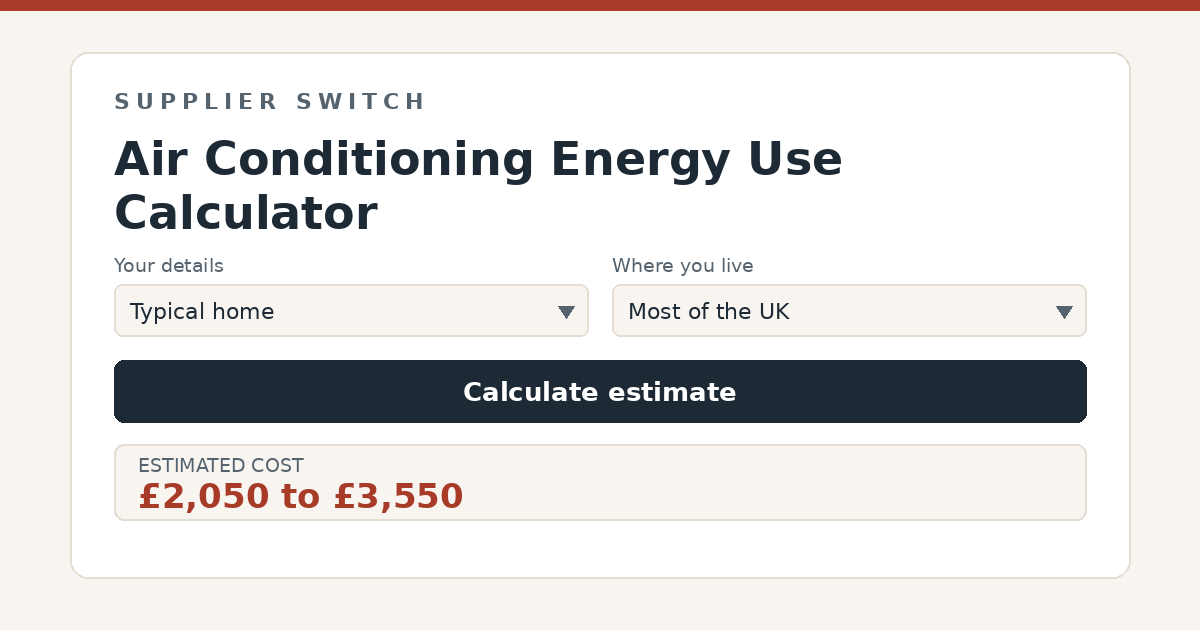
Cooling a typical living room across a UK summer costs roughly to at 2026 electricity prices, built from real-world figures of about 10 to 20 pence per hour for a 2.5 kW bedroom unit, 19 to 30 pence for a 3.5 kW lounge unit and 32 to 49 pence for a 5 kW open plan unit at the current 24.7 to 26.1 pence per kWh caps. The numbers surprise most people downwards, because inverter units spend most of each session ticking over at a fraction of their rated power once the room is cool.
Days of use per summer
UK cooling seasons are short and spiky: most households run air conditioning on 10 to 30 genuinely hot days a year, with heatwave summers pushing higher and bedroom-only users lower. Enter the days you realistically expect, since this single number scales the whole estimate.
Hours per day
Running hours scale cost almost linearly, with one nuance in your favour: an inverter unit works hardest in its first half hour pulling the room down to temperature, then throttles back to a fraction of its rated power to hold it, so the second four hours of a session cost less than the first. Overnight bedroom cooling at a moderate set point is the classic cheap-comfort pattern, roughly to a night for a typical bedroom unit.
Unit size
Unit sizes follow room sizes at roughly 0.1 kW of cooling per square metre: a 2.5 kW unit suits a bedroom, 3.5 kW a typical lounge, and 5 kW an open plan space. Once the room is at temperature, real-world draw is a fraction of the rating, roughly 0.5 to 0.7 kW for a 2.5 kW inverter unit, which is why the running figures are lower than the nameplate arithmetic suggests. Multiply mentally for multi-room systems, or run the calculator per room.
Unit efficiency
Inverter compressors modulate to the load and dominate modern installations; older fixed-speed units cycle flat-out and cost 40 to 60 percent more for the same cooling. Portable units fare worst of all, running near full power constantly while their exhaust hose leaks cooled air and pulls warm air in through every gap, which is why a small fixed split often costs less per summer than the cheap portable it replaces.
What else affects the figures
Set point discipline is the cheapest efficiency upgrade: holding around 24 degrees Celsius rather than driving the unit to its minimum cuts consumption sharply for comfort few can distinguish, and closing windows, blinds against direct sun and doors to unused rooms all shrink the load the unit must fight. Remember that almost every modern split system also heats, at heat pump efficiency of three to four units of warmth per unit of electricity, so the same machine that costs a summer to cool can trim winter heating bills in the rooms it serves, improving the economics of the to installation considerably. Servicing keeps the story honest, since clogged filters quietly raise consumption, and anyone still cooling with a portable unit through every heatwave has, in the running cost gap, most of the argument for a proper installation.
Certification, planning and grid connection
Appliance running costs move with the Ofgem price cap, so every figure here shifts a little each quarter, and time-of-use tariffs increasingly reward shifting flexible usage into cheap windows, which suits appliances that do not care when they run. Energy labels remain the quickest like-for-like efficiency comparison when buying, and for fixed installations such as air conditioning, F-Gas certified installation is a legal requirement while permitted development rules govern outdoor condenser placement, with listed buildings and conservation areas needing consent. Nothing on this page requires planning permission or building control in normal domestic use.
Sources
The typical prices, yields and scheme details used by this calculator draw on the following published resources, which are good starting points for further research: