Supplier Switch
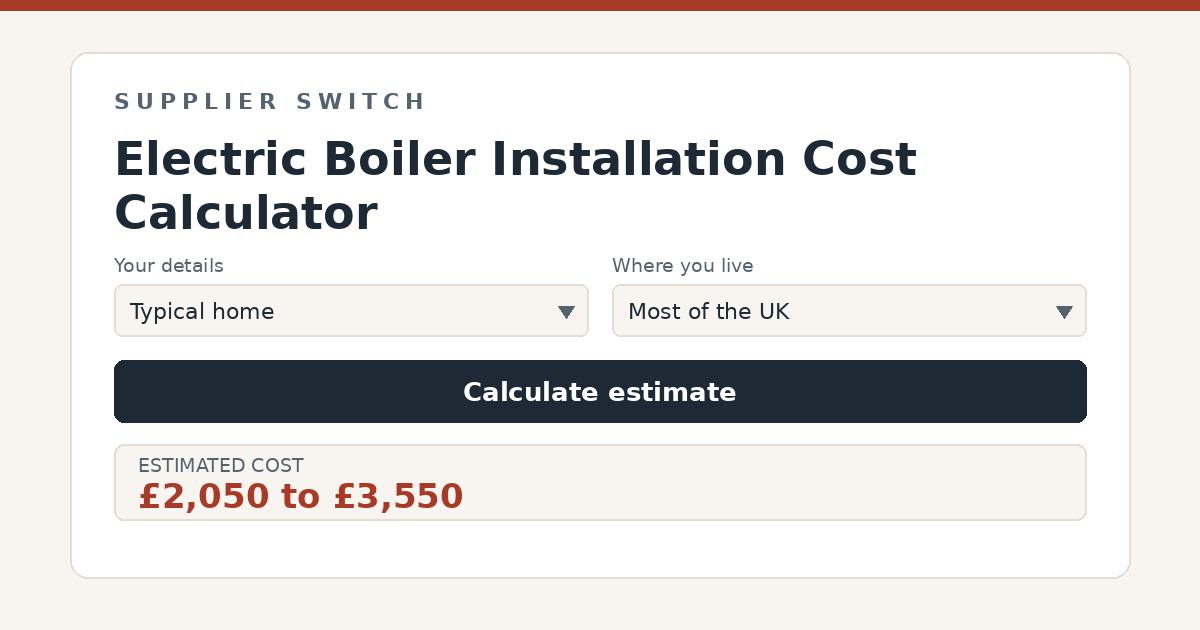
Electric Boiler Installation Cost Calculator
Estimate the cost of installing an electric boiler, the compact gas-free option for flats and off-grid homes, with an honest account of the running costs that follow.
Estimated installed cost
All figures are indicative ranges based on published UK guides and scheme documentation. Real quotes, running costs and savings vary – see the explainer and disclaimer below.
How this calculator works
This calculator works in ranges rather than single figures, because real quotes, yields and tariffs genuinely vary that much. It starts from typical UK price, output and savings ranges drawn from published 2026 industry guides and official scheme documentation, then scales them by the quantities you enter and adjusts them for each choice you make below. The result is a low-to-high band that a realistic outcome is likely to fall within, not a promise of the figure you will achieve.
An electric boiler costs roughly to installed in 2026, often less than a gas boiler since there is no flue, no gas pipework and no Gas Safe requirement, and the unit itself is compact enough for a cupboard. The economy reverses at the meter: electricity at 24.7 to 26.1 pence per kWh against gas around 6 pence means heating a typical home electrically costs to a year where gas would cost around to .
Home size
Home size scales the installation estimates: larger homes need higher output units, bigger cylinders where fitted and sometimes more pipework, while flats and small houses sit below the three bedroom baseline that published guide prices describe. It does not scale the running cost figures, which follow the demand number you enter instead.
Electric boiler type
Direct electric boilers heat water for radiators on demand, the simplest and cheapest unit. Electric combis add a small internal store to improve hot water delivery, and full system setups pair the boiler with a hot water cylinder, adding the cylinder’s cost but enabling cheap overnight charging on Economy 7 style tariffs, which is the main lever for taming electric heating bills.
Electrical supply
Electric boilers draw serious current, typically 9 to 14.4 kW, which needs its own circuit and a consumer unit with capacity to spare. Older fuse boards often need upgrading at to , and the largest boilers can prompt a chat with the network operator about the property’s supply fuse. An electrician’s assessment before ordering avoids the classic surprise on installation day.
Where you live
Heating labour is not priced uniformly across the UK, with published guides putting London and South East installation quotes roughly 15 to 25 percent above the national average. The hardware costs the same everywhere, so the difference sits in engineer day rates, access and parking.
What else affects the figures
Electric boilers therefore suit specific homes: flats that cannot take a flue or outdoor unit, small and very well insulated properties, listed buildings, and low-usage homes such as holiday lets where the installation saving outweighs the running premium. For everyone else considering electric heating, the modern answer is usually a heat pump, which delivers the same gas-free result at a third of the running cost and qualifies for the Boiler Upgrade Scheme grant that electric boilers do not. Where an electric boiler is the right call, an off-peak tariff with a well insulated cylinder charged overnight, or increasingly a smart time-of-use tariff, claws back a meaningful share of the running cost, and the installation itself needs a qualified electrician working to Part P rather than a gas engineer.
Certification, planning and grid connection
Electric boilers and heaters need no Gas Safe engineer, but the electrical work is regulated in its own right: new circuits and consumer unit work fall under Part P of the Building Regulations and belong to a qualified electrician who can self-certify through a competent person scheme. High-output electric boilers need supply capacity checking before purchase, occasionally involving the network operator, and any storage-based strategy relies on tariff choice, so confirming Economy 7 or smart tariff availability with your supplier is part of the design rather than an afterthought. Electric heating carries no flue, no condensate and no annual gas safety requirements, one of its genuine conveniences.
Sources
The typical prices, yields and scheme details used by this calculator draw on the following published resources, which are good starting points for further research: