
Supplier Switch
Water Heater vs Boiler Cost Calculator
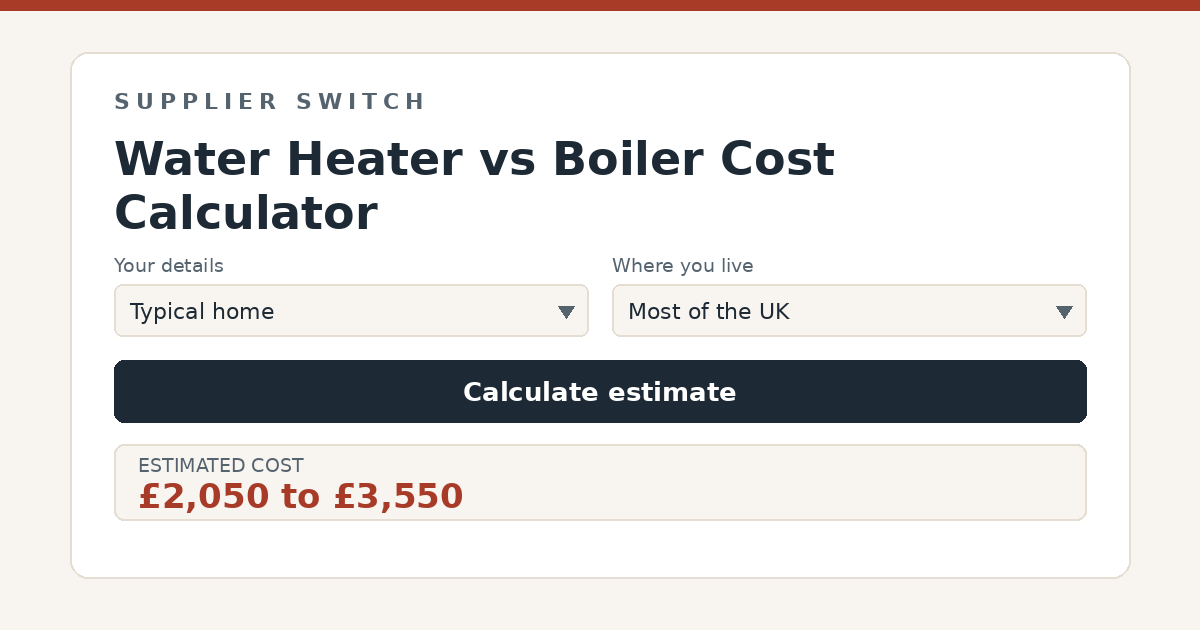
Compare a dedicated electric water heater against boiler-supplied hot water, on running cost for the water you use and the installation each requires.
Water heater running cost
Boiler running cost
Estimated annual running cost difference
Water heater
Gas boiler
Installation cost difference (context only)
All figures are indicative ranges based on published UK guides and scheme documentation. Real quotes, running costs and savings vary – see the explainer and disclaimer below.
How this calculator works
This calculator works in ranges rather than single figures, because real quotes, yields and tariffs genuinely vary that much. It starts from typical UK price, output and savings ranges drawn from published 2026 industry guides and official scheme documentation, then scales them by the quantities you enter and adjusts them for each choice you make below. The result is a low-to-high band that a realistic outcome is likely to fall within, not a promise of the figure you will achieve.
For whole-household hot water, the boiler wins on running cost by roughly four to one, to a year by gas against to by standard-rate electric heating for a typical household’s 3000 kWh in 2026. The water heater’s case is the small job: a point-of-use unit at to installed serving a distant cloakroom or outbuilding costs pennies a day to run and beats both the pipework cost and the wasted water of running a far-off tap hot from the boiler.
Annual hot water energy (kWh)
This is the energy your hot water needs over a year: roughly 2500 to 3500 kWh for a typical household’s showers, baths and taps, or as little as 100 to 300 kWh for a single point-of-use sink. Scale it to what the water heater would actually serve, since that is the honest comparison.
Water heater tariff
Electric water heating on the standard cap pays 24.7 to 26.1 pence per kWh; cylinder-based heaters timed into off-peak windows nearly halve that, while point-of-use units heating on demand pay whatever rate applies at the moment of use. The boiler figure is priced on standard cap gas rates through a modern condensing boiler.
Where you live
Heating labour is not priced uniformly across the UK, with published guides putting London and South East installation quotes roughly 15 to 25 percent above the national average. The hardware costs the same everywhere, so the difference sits in engineer day rates, access and parking.
What else affects the figures
Distance and duty decide this comparison: hot water pipes lose heat and waste water in proportion to their length, so a sink twenty metres from the boiler genuinely can be cheaper served by its own small heater, especially for hand-washing volumes, while showers, baths and kitchens belong on the boiler or a proper cylinder. All-electric homes reframe the question as tariff strategy, where a well insulated cylinder on off-peak rates is the established answer and an unvented mains-pressure cylinder at to the premium version, legally installed by G3-qualified engineers. And summer deserves its footnote: households with solar panels can divert surplus generation into an immersion or cylinder heater, making the electric option briefly the cheapest hot water in the house, one more reason the cylinder is quietly returning to favour.
Certification, planning and grid connection
Hot water work splits along a regulatory line: vented cylinders and point-of-use heaters are ordinary plumbing and Part P electrical work, while unvented pressurised cylinders are legally restricted to G3-qualified installers and are notifiable under Building Regulations, because a sealed cylinder of hot water is a pressure vessel whose safety devices and discharge pipework must be right. Immersion heater circuits belong to qualified electricians, water byelaws govern connections and backflow protection, and in hard water areas scale protection is worth specifying at installation. Cylinder thermostats around 60 to 65 degrees Celsius balance legionella safety against scale and running cost.
Sources
The typical prices, yields and scheme details used by this calculator draw on the following published resources, which are good starting points for further research: