
Supplier Switch
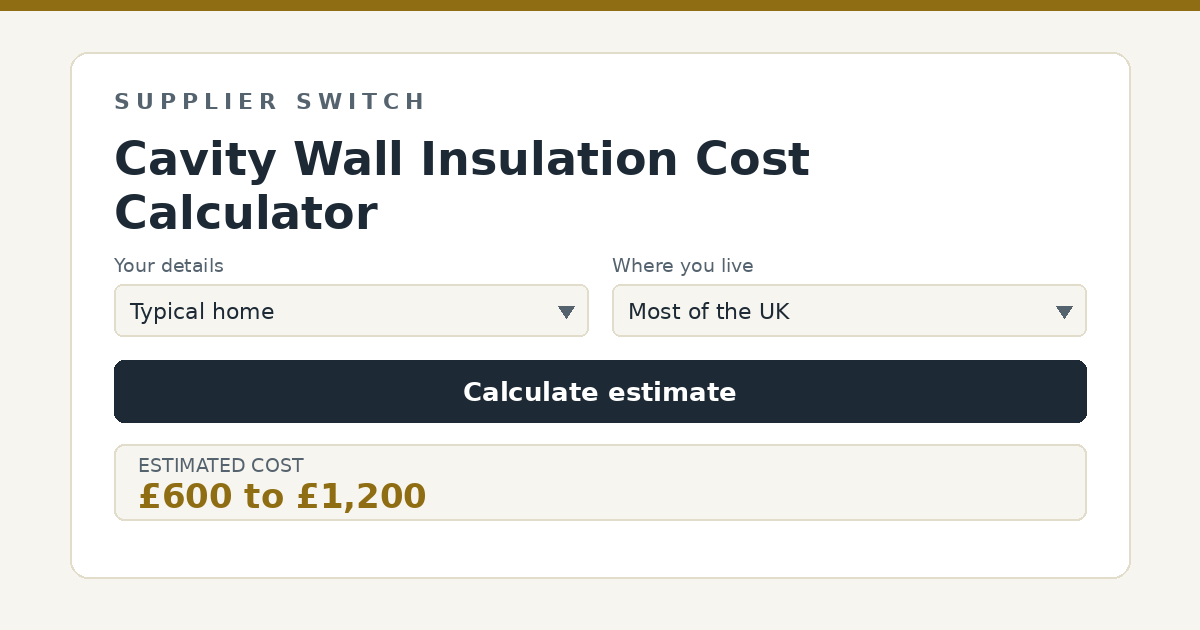
Cavity Wall Insulation Cost Calculator
Estimate the cost of injected cavity wall insulation, the standard treatment for homes built between the 1920s and 1990s with an unfilled gap between two masonry leaves.
Estimated installed cost
All figures are indicative ranges based on published UK guides and scheme documentation. Real quotes, running costs and savings vary – see the explainer and disclaimer below.
How this calculator works
This calculator works in ranges rather than single figures, because real quotes, yields and tariffs genuinely vary that much. It starts from typical UK price, output and savings ranges drawn from published 2026 industry guides and official scheme documentation, then scales them by the quantities you enter and adjusts them for each choice you make below. The result is a low-to-high band that a realistic outcome is likely to fall within, not a promise of the figure you will achieve.
Cavity wall insulation costs roughly to per square metre installed, putting a typical semi-detached home at to and a mid-terrace under in 2026, for a job that takes two to four hours: the installer drills small holes in the mortar joints, injects the fill, and makes good. Around a third of an uninsulated home’s heat leaves through the walls, and filling the cavity saves in the region of to a year for a semi, one of the fastest paybacks available.
Property type
The treatable wall area drives the price: a mid-terrace exposes only front and back walls, while a detached house exposes all four. Small jobs carry a higher rate per square metre because survey, set-up and minimum call-out costs spread across less wall, which the calculator reflects. Your installer’s survey will measure the true area and check the cavity’s width and condition with a borescope.
Fill material
Blown mineral wool is the traditional and cheapest fill. EPS bonded beads cost around 20 percent more but flow better through narrow or partially obstructed cavities, resist moisture tracking and are the usual recommendation in exposed, driving-rain locations. Polyurethane foam fills exist for special cases at a further premium, though lender caution around foam products makes beads the safer premium choice for most homes.
Where you live
Installation labour is not priced uniformly across the UK, with published guides putting London and South East insulation quotes roughly 15 to 25 percent above the national average. Materials are broadly national in price, so the difference sits mostly in labour, access and parking.
What else affects the figures
Suitability is the crucial check: cavities narrower than 50 mm, walls in severe driving-rain exposure, existing partial fill and poorly maintained brickwork can all make injection unwise, and a proper pre-installation borescope survey plus a CIGA or equivalent 25 year guarantee separates reputable installers from the vans that follow grant schemes around. Done right in a suitable wall it is trouble-free for decades; done wrong in an exposed or damp wall it can track moisture, which is the source of most cavity insulation horror stories. This is also the most heavily grant-funded measure in the UK, with ECO4 and the Great British Insulation Scheme covering the full cost for many eligible households, so checking eligibility before paying is simply sensible.
Certification, planning and grid connection
Adding insulation to an existing element generally needs no planning permission, but Building Regulations Approved Document L applies whenever a thermal element is renovated or replaced, setting U-value targets the work should meet, and some measures are notifiable through building control or a competent person scheme, which reputable installers handle as standard. Ventilation is the companion rule: a better-insulated, more airtight home needs deliberate air movement, so eaves gaps, airbricks, trickle vents and extractor fans must be preserved or improved alongside the insulation. Grant support is substantial, with ECO4 running to 31 December 2026 and the Great British Insulation Scheme funding measures for eligible households, both requiring TrustMark-registered or suitably certified installers, and domestic insulation carries 0 percent VAT until 31 March 2027.
Sources
The typical prices, yields and scheme details used by this calculator draw on the following published resources, which are good starting points for further research: