
Supplier Switch
Insulation Cost Calculator
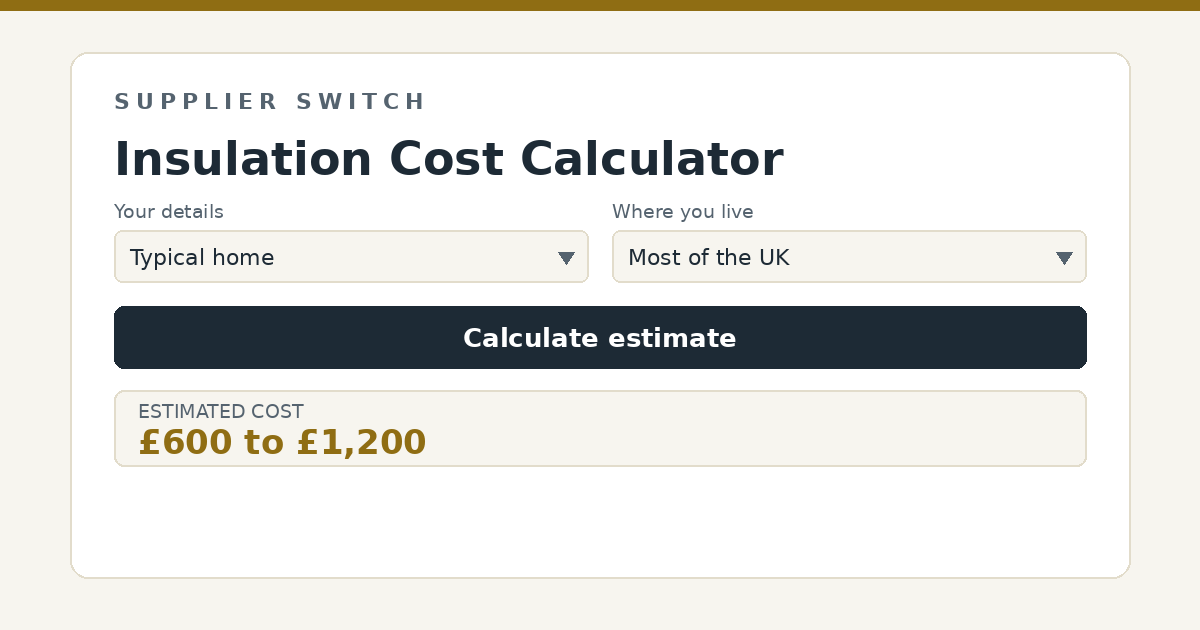
Estimate the cost of insulating any part of a UK home, from loft rolls to solid wall systems, using typical 2026 installed prices per square metre.
Estimated installed cost
All figures are indicative ranges based on published UK guides and scheme documentation. Real quotes, running costs and savings vary – see the explainer and disclaimer below.
How this calculator works
This calculator works in ranges rather than single figures, because real quotes, yields and tariffs genuinely vary that much. It starts from typical UK price, output and savings ranges drawn from published 2026 industry guides and official scheme documentation, then scales them by the quantities you enter and adjusts them for each choice you make below. The result is a low-to-high band that a realistic outcome is likely to fall within, not a promise of the figure you will achieve.
Home insulation in the UK runs from around for a basic loft top-up to over for external wall insulation on a large detached house, with a typical three bedroom semi needing roughly to of loft, cavity and draught-proofing work that then saves to a year at 2026 energy prices. All domestic insulation installations carry 0 percent VAT until 31 March 2027, a saving already reflected in quoted prices.
Area to insulate (square metres)
Enter the area you want to insulate. As a guide, a typical semi-detached home has a loft floor of 40 to 55 square metres, external walls of 70 to 90 square metres, and a ground floor of 40 to 50 square metres. Measuring roughly and rounding up slightly is fine for budgeting, since installers quote from their own survey measurements anyway.
Insulation measure
The measures differ enormously in cost per square metre because the labour differs: laying mineral wool across a loft floor costs around to per square metre, injecting a cavity to , insulating between floor joists to , lining solid walls internally to , boarding between and under rafters to , and full external wall systems with render to . The cheap measures also happen to be the ones that save the most per pound spent, which is why loft and cavity insulation come first in almost every retrofit plan.
Where you live
Installation labour is not priced uniformly across the UK, with published guides putting London and South East insulation quotes roughly 15 to 25 percent above the national average. Materials are broadly national in price, so the difference sits mostly in labour, access and parking.
What else affects the figures
Sequencing matters more than perfection: heat escapes through the whole envelope, roughly a quarter through an uninsulated roof and a third through walls, so the standard order is loft, then cavity walls, then draught-proofing, with floors and solid walls following as budget allows. Grant support is substantial for eligible households, with ECO4 running to 31 December 2026 and the Great British Insulation Scheme funding single measures for a wider group, in many cases covering the entire cost. Every measure also has a condensation dimension, since a warmer, more airtight home needs deliberate ventilation, and reputable installers assess this rather than simply stuffing material in.
Certification, planning and grid connection
Adding insulation to an existing element generally needs no planning permission, but Building Regulations Approved Document L applies whenever a thermal element is renovated or replaced, setting U-value targets the work should meet, and some measures are notifiable through building control or a competent person scheme, which reputable installers handle as standard. Ventilation is the companion rule: a better-insulated, more airtight home needs deliberate air movement, so eaves gaps, airbricks, trickle vents and extractor fans must be preserved or improved alongside the insulation. Grant support is substantial, with ECO4 running to 31 December 2026 and the Great British Insulation Scheme funding measures for eligible households, both requiring TrustMark-registered or suitably certified installers, and domestic insulation carries 0 percent VAT until 31 March 2027.
Sources
The typical prices, yields and scheme details used by this calculator draw on the following published resources, which are good starting points for further research: