
Supplier Switch
Roof Insulation Cost Calculator
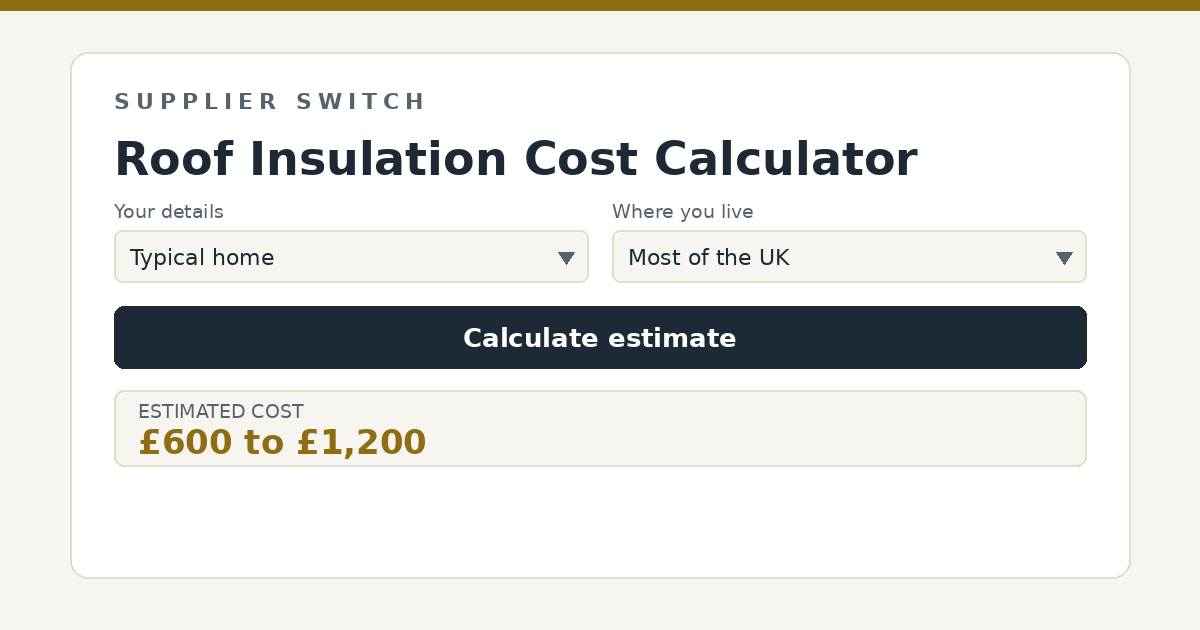
Estimate the cost of insulating a pitched roof at rafter level, the warm-roof approach used for loft conversions, room-in-roof spaces and lofts kept in use.
Estimated installed cost
All figures are indicative ranges based on published UK guides and scheme documentation. Real quotes, running costs and savings vary – see the explainer and disclaimer below.
How this calculator works
This calculator works in ranges rather than single figures, because real quotes, yields and tariffs genuinely vary that much. It starts from typical UK price, output and savings ranges drawn from published 2026 industry guides and official scheme documentation, then scales them by the quantities you enter and adjusts them for each choice you make below. The result is a low-to-high band that a realistic outcome is likely to fall within, not a promise of the figure you will achieve.
Rafter-level roof insulation costs roughly to per square metre installed in 2026, putting a typical roof at to and a full room-in-roof upgrade beyond that, several times the cost of insulating the loft floor. The premium buys usable space: rafter insulation keeps the loft itself warm, which is essential for conversions and valuable for any loft in regular use.
Area to insulate (square metres)
Measure the roof slope area being insulated, not the floor below it: slope length times width for each pitch. A typical semi’s two main slopes total 60 to 90 square metres, and room-in-roof jobs often include small vertical walls and ceiling flats that count towards the area.
Method
The standard retrofit fits rigid PIR between the rafters, keeping a 50 mm air gap behind, with a continuous insulated layer beneath them to break the cold bridging. A full room-in-roof job adds plasterboard, skim and finishing on top of the insulation cost. If the roof covering is being replaced anyway, insulating over the rafters as a warm roof is more efficient and cheaper per square metre, since the scaffolding and stripping are already paid for, which is why re-roofing is the golden moment for this measure.
Where you live
Installation labour is not priced uniformly across the UK, with published guides putting London and South East insulation quotes roughly 15 to 25 percent above the national average. Materials are broadly national in price, so the difference sits mostly in labour, access and parking.
What else affects the figures
The choice between insulating the loft floor and the roof slope is really a choice about what the loft is for: an unused loft is far cheaper to insulate at floor level, while a converted or convertible one justifies rafter work. PIR dominates the application because its thermal performance hits the Building Regulations target of around 0.15 to 0.18 in workable thicknesses, where mineral wool would need depths that swallow the room; wood fibre offers a breathable eco alternative at a premium suited to older and timber-framed buildings. The unbreakable rule is the ventilated air gap between insulation and the roofing felt or membrane, without which condensation quietly attacks the timbers. Loft conversions bring the whole job under Building Regulations approval, which a converter handles as standard.
Certification, planning and grid connection
Adding insulation to an existing element generally needs no planning permission, but Building Regulations Approved Document L applies whenever a thermal element is renovated or replaced, setting U-value targets the work should meet, and some measures are notifiable through building control or a competent person scheme, which reputable installers handle as standard. Ventilation is the companion rule: a better-insulated, more airtight home needs deliberate air movement, so eaves gaps, airbricks, trickle vents and extractor fans must be preserved or improved alongside the insulation. Grant support is substantial, with ECO4 running to 31 December 2026 and the Great British Insulation Scheme funding measures for eligible households, both requiring TrustMark-registered or suitably certified installers, and domestic insulation carries 0 percent VAT until 31 March 2027.
Sources
The typical prices, yields and scheme details used by this calculator draw on the following published resources, which are good starting points for further research: