
Supplier Switch
Home Solar Panels vs Wind Turbines Cost Calculator
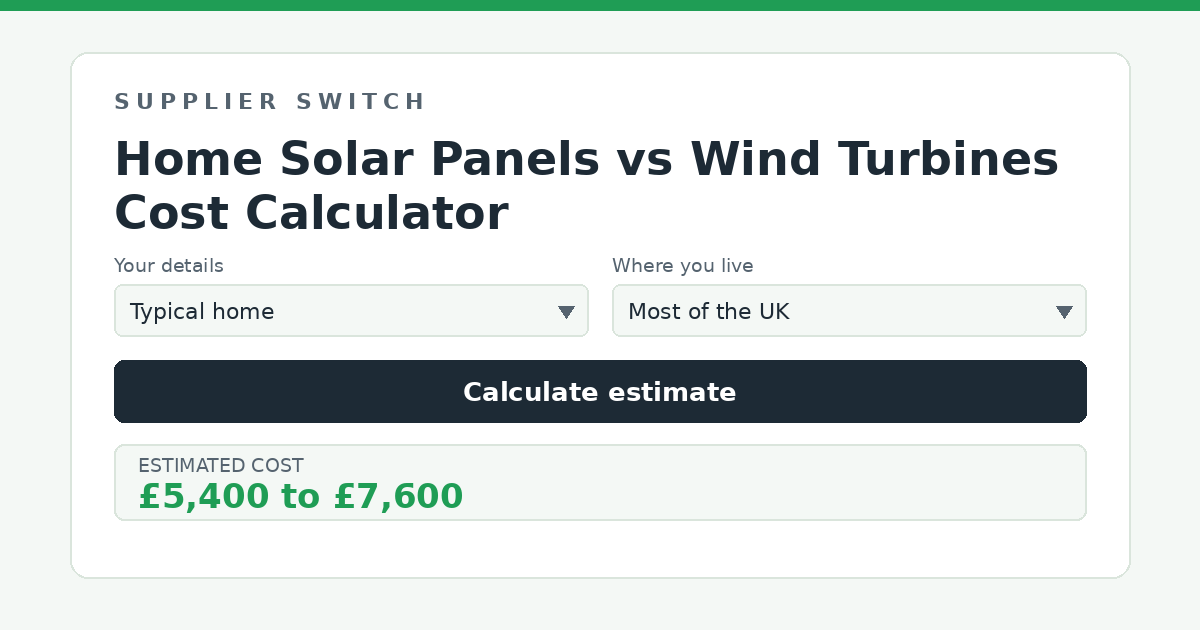
Compare the cost of home solar panels against a domestic wind turbine of the same rated capacity, the two headline options for generating your own electricity at home.
Pole-mounted wind turbine
Solar panel system
Estimated cost difference
All figures are indicative ranges based on published UK guides and scheme documentation. Real quotes, generation and savings vary – see the explainer and disclaimer below.
How this calculator works
This calculator works in ranges rather than single figures, because real quotes, yields and tariffs genuinely vary that much. It starts from typical UK price, output and savings ranges drawn from published 2026 industry guides and official scheme documentation, then scales them by the quantities you enter and adjusts them for each choice you make below. The result is a low-to-high band that a realistic outcome is likely to fall within, not a promise of the figure you will achieve.
Home solar costs roughly to per kW installed in 2026, while a properly installed pole-mounted wind turbine costs roughly to per kW, with a typical 5 to 6 kW turbine landing at to all-in. Small roof-mounted turbines exist at to , but in built-up areas turbulence usually reduces their output to a trickle, which is why the Energy Saving Trust steers most households towards solar.
Rated capacity to compare
Both technologies are rated in kilowatts of peak capacity, but they convert capacity to annual energy differently: UK solar delivers roughly 850 kWh per kW per year, while a pole-mounted turbine on a genuinely windy rural site can deliver 1500 to 2500 kWh per kW, and a turbine on a poor site far less than solar. Comparing at equal capacity is the convention, but the honest comparison for your site is annual kWh per pound spent.
What else affects the figures
Wind only competes on genuinely windy sites: an average wind speed of at least 5 metres per second, open exposure without nearby buildings or trees, and space for a mast, conditions met by rural and coastal properties rather than suburban ones. Where those conditions exist, wind generates in winter and at night when solar cannot, and the two pair well together. Wind also carries planning requirements that solar rarely does, plus moving-part maintenance of several hundred pounds a year and periodic inverter and bearing replacements. For the large majority of UK homes, solar delivers far more energy per pound with none of the siting risk; wind is a specialist choice for the right site rather than a general alternative.
Certification, planning and grid connection
If a calculation here prompts a project, the practical next step is an MCS-certified installer’s survey: MCS installers must provide a location-specific generation estimate using the standard industry methodology, which turns the broad ranges on this page into a figure for your actual roof. Most domestic solar work falls under permitted development, with the usual exceptions for listed buildings, flats and conservation areas, and installations must be notified to the district network operator under the G98 or G99 procedures, which a competent installer handles as part of the job.
Sources
The typical prices, yields and scheme details used by this calculator draw on the following published resources, which are good starting points for further research: