
Supplier Switch
How Many Solar Panels Do I Need Calculator
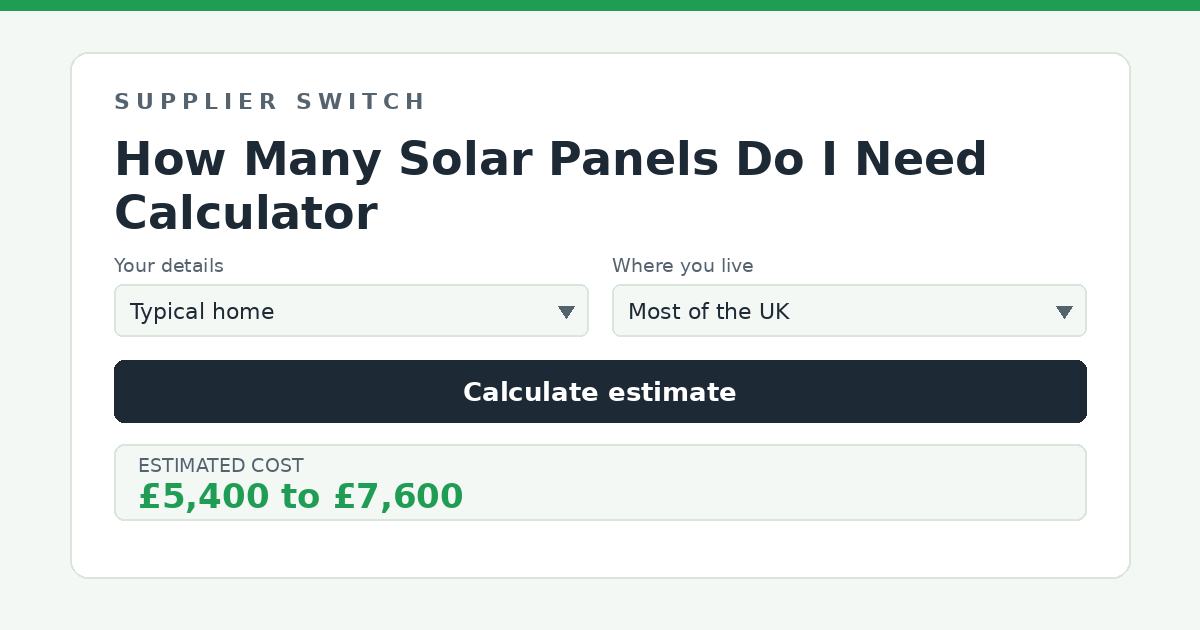
Work out how many solar panels, and what system size, you would need to cover a chosen share of your household’s annual electricity use.
Estimated panels needed
Estimated system size
All figures are indicative ranges based on published UK guides and scheme documentation. Real quotes, generation and savings vary – see the explainer and disclaimer below.
How this calculator works
This calculator works in ranges rather than single figures, because real quotes, yields and tariffs genuinely vary that much. It starts from typical UK price, output and savings ranges drawn from published 2026 industry guides and official scheme documentation, then scales them by the quantities you enter and adjusts them for each choice you make below. The result is a low-to-high band that a realistic outcome is likely to fall within, not a promise of the figure you will achieve.
As a rule of thumb, a UK home needs roughly 1 kWp of solar, a little over two modern panels, for every 850 kWh of annual electricity it wants to generate. The average household using around 3500 kWh a year therefore needs approximately a 4 kWp system of 9 to 11 panels to match its usage, occupying roughly 20 square metres of roof.
Annual electricity use (kWh)
Your annual usage in kilowatt-hours is on your energy bill or online account; the Ofgem typical value for a medium household is around 2700 kWh, while homes with electric heating, hot tubs or electric vehicles use far more. The more accurately you know this number, the better the sizing estimate, and it is worth using a full year’s figure to capture seasonal swings.
Generation target
Matching your annual usage does not mean grid independence: solar generates in daytime and summer while you also use power at night and in winter, so even a system that generates 100 percent of your annual demand typically supplies 30 to 50 percent of it directly without a battery, exporting the rest. Sizing to half or three quarters of usage suits smaller roofs and budgets; sizing to or beyond full usage suits homes planning a battery, EV or heat pump.
Panel wattage
Modern residential panels are typically 400 to 500 watts each, with 430 to 450 W the 2026 sweet spot. Higher wattage panels produce the same system size with fewer units, which helps on small roofs, though the panels themselves are physically slightly larger. Panel count is a packaging question; the kWp total is what determines generation.
Region (solar resource)
The sunnier your region, the fewer panels you need for the same annual energy. A home in southern England needs roughly 5 percent fewer panels than the UK average to hit a given target, while a home in Scotland needs roughly 10 to 15 percent more, because each installed kWp generates less there over the year.
What else affects the figures
Roof space is the practical constraint: each modern panel occupies about 2 square metres, and layouts must dodge chimneys, roof windows, vents and required edge margins, so a surveyor’s layout often trims a panel or two from the theoretical answer. It is generally worth installing as much as the roof sensibly holds even if it exceeds today’s usage, because fixed costs make marginal panels cheap, and future EVs or heat pumps will absorb the surplus. Systems above 3.68 kWp of inverter output per phase need district network operator permission via a G99 application before commissioning, which a competent installer handles as standard.
Certification, planning and grid connection
If a calculation here prompts a project, the practical next step is an MCS-certified installer’s survey: MCS installers must provide a location-specific generation estimate using the standard industry methodology, which turns the broad ranges on this page into a figure for your actual roof. Most domestic solar work falls under permitted development, with the usual exceptions for listed buildings, flats and conservation areas, and installations must be notified to the district network operator under the G98 or G99 procedures, which a competent installer handles as part of the job.
Sources
The typical prices, yields and scheme details used by this calculator draw on the following published resources, which are good starting points for further research: