
Supplier Switch
Solar Hot Water System Cost Calculator
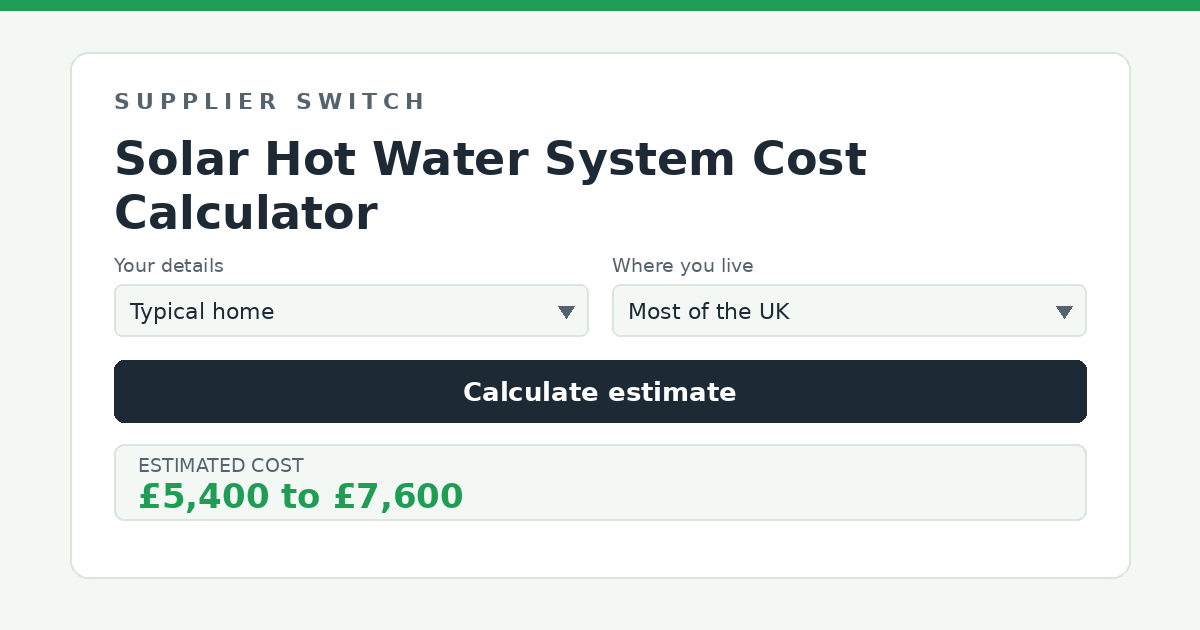
Estimate the cost of a solar thermal hot water system, which uses roof collectors to heat water directly, typically covering 40 to 60 percent of a household’s annual hot water needs.
Estimated installed cost
All figures are indicative ranges based on published UK guides and scheme documentation. Real quotes, generation and savings vary – see the explainer and disclaimer below.
How this calculator works
This calculator works in ranges rather than single figures, because real quotes, yields and tariffs genuinely vary that much. It starts from typical UK price, output and savings ranges drawn from published 2026 industry guides and official scheme documentation, then scales them by the quantities you enter and adjusts them for each choice you make below. The result is a low-to-high band that a realistic outcome is likely to fall within, not a promise of the figure you will achieve.
A domestic solar hot water system typically costs to fully installed in 2026, with an average around , covering the collectors, pump, controller, pipework and labour. A well sized system delivers roughly 1000 to 2500 kWh of heat per year, meeting most of a household’s hot water demand in summer and 20 to 40 percent in winter, with the boiler or immersion heater topping up the rest.
Collector type
Flat plate collectors are the established, lower-cost option and perform well in direct sunshine. Evacuated tube collectors cost roughly 15 to 25 percent more but capture 15 to 20 percent more heat in cloudy and cold conditions, which makes them the usual recommendation in northern parts of the UK. Over a full year on a typical home the performance gap is narrower than the brochures suggest.
Household size
Systems are sized to hot water demand, with a typical family home needing 2 to 4 square metres of collector area and a suitably sized cylinder. Larger households need more collector area and larger cylinders, which pushes the price up modestly; the labour and control components are much the same at any size.
Hot water cylinder
Solar thermal needs a cylinder with a dedicated solar coil. If your existing cylinder is already twin-coil compatible, that cost disappears; most retrofits need a new cylinder at roughly to supplied and fitted. Homes with combi boilers and no cylinder at all need the most additional work, and are often better served by solar PV with an immersion diverter instead.
Where you live
Installation labour is not priced uniformly across the UK. Published guides put London and South East installation costs roughly 15 to 25 percent above the national average, reflecting labour rates, access and parking. Hardware prices are broadly national, so the difference is mostly in the fitting.
What else affects the figures
Unlike solar PV, solar thermal does not currently enjoy 0 percent VAT in all cases and earns no Smart Export Guarantee income, since it produces heat rather than electricity, so the financial case rests entirely on displaced water-heating fuel, typically worth to per year depending on whether you heat water with gas or electricity. Running costs are minimal, mainly to a year of pump electricity, plus a glycol antifreeze change every five to ten years. Many 2026 buyers comparing options land on solar PV with a to immersion diverter instead, which heats water with surplus electricity while keeping the flexibility of PV; solar thermal remains strongest where hot water demand is unusually high.
Certification, planning and grid connection
Solar thermal collectors generally fall under permitted development on houses, subject to the usual 200 millimetre projection limit and stricter rules for listed buildings and conservation areas, so check with your local planning authority if either applies. Choose an MCS-certified installer for quality assurance even though solar thermal earns no Smart Export Guarantee, since it generates heat rather than electricity. VAT treatment differs from solar PV and is worth confirming on your quote, and unvented cylinder work must be carried out by a suitably qualified installer under the building regulations, with the cylinder notified to building control where required.
Sources
The typical prices, yields and scheme details used by this calculator draw on the following published resources, which are good starting points for further research: