
Supplier Switch
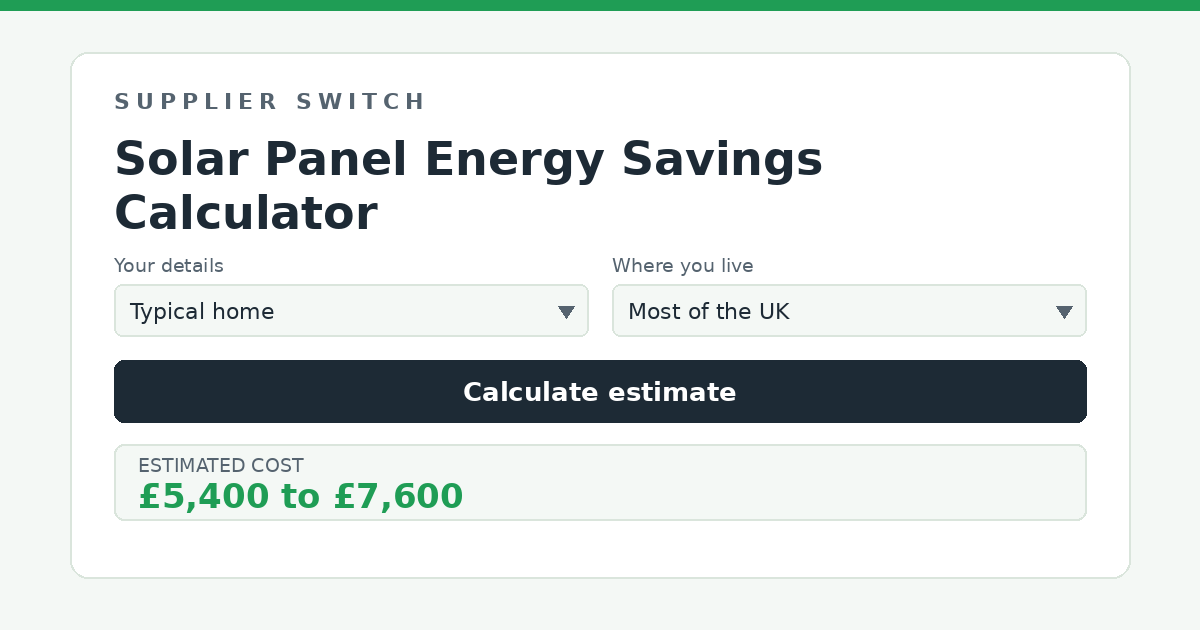
Solar Panel Energy Savings Calculator
Estimate how much a solar panel system could reduce your annual electricity costs, combining bill savings from using your own power with Smart Export Guarantee income from selling the surplus.
Estimated annual savings
All figures are indicative ranges based on published UK guides and scheme documentation. Real quotes, generation and savings vary – see the explainer and disclaimer below.
How this calculator works
This calculator works in ranges rather than single figures, because real quotes, yields and tariffs genuinely vary that much. It starts from typical UK price, output and savings ranges drawn from published 2026 industry guides and official scheme documentation, then scales them by the quantities you enter and adjusts them for each choice you make below. The result is a low-to-high band that a realistic outcome is likely to fall within, not a promise of the figure you will achieve.
A typical 4 kWp system saves a UK household roughly to a year at 2026 prices before export income, with a battery and a decent export tariff pushing total annual value towards to or more. Published FMB modelling puts combined savings for a 4.5 kWp system with battery at to a year, while conservative estimates without a battery sit nearer the bottom of the range.
System size
Solar systems are sized in kilowatts peak (kWp), the output of the panels under standard test conditions. A 4 kWp system of around 10 modern panels is the most common choice for a UK three bedroom home, while larger households, or homes with an electric vehicle or heat pump, often go to 6 kWp or more. Bigger systems cost less per kWp because fixed costs such as scaffolding, the inverter and installer overheads are spread across more panels, and the calculator reflects that economy of scale.
Usage pattern
Two identical roofs can produce very different savings. Solar electricity is worth most when you use it yourself, displacing grid imports at roughly 25 to 26 pence per kWh under the 2026 price cap, and least when exported at typical SEG rates. A household out all day self-consumes perhaps 25 to 35 percent of generation; someone home during the day 40 to 55 percent; and a battery pushes self-consumption to 70 to 85 percent, which is why it lifts savings by roughly a third.
Export tariff
The Smart Export Guarantee obliges larger suppliers to pay something for exported electricity, but rates vary enormously, from a token few pence to 15 or 20 pence per kWh on the most competitive tariffs, some of which require the supplier’s own installation or a battery. A 4 kWp system typically exports around 2000 kWh a year, so the difference between a poor and a good export rate is worth to annually and switching is well worth the paperwork.
Region (solar resource)
The same panels generate more in Cornwall than in Caithness. The industry baseline is around 850 kWh per year for every kWp installed on an unshaded south-facing roof in an average UK location, with southern England running around 5 percent above that and Scotland 10 to 15 percent below. The calculator scales its output and savings figures accordingly.
What else affects the figures
Savings scale with the electricity price, so they move each time the Ofgem price cap changes, and with how much of your generation you consume rather than export. The calculator assumes an unshaded, broadly south-facing roof; east-west roofs produce around 15 percent less and shading can cost far more. Habits matter as much as hardware: running the dishwasher, washing machine and EV charging during sunny hours, or fitting an immersion diverter to heat water with surplus power, all shift generation from low-value export to high-value self-use without spending anything on a battery.
Certification, planning and grid connection
Most home solar installations fall under permitted development and need no planning permission, provided panels do not protrude more than 200 millimetres from the roof plane, though listed buildings and flats have tighter rules and conservation areas restrict panels on walls fronting the highway, so check with your local planning authority if any apply. Use an MCS-certified installer: certification is required to register for Smart Export Guarantee payments and is the industry marker of a compliant installation. Your installer must also notify or seek approval from the district network operator, automatically for systems up to 3.68 kW per phase under G98 and by prior application under G99 above that. Residential solar and battery installations carry 0 percent VAT until 31 March 2027, after which the rate is due to revert to 5 percent.
Sources
The typical prices, yields and scheme details used by this calculator draw on the following published resources, which are good starting points for further research: