
Supplier Switch
Bow Windows Installation and Replacement Cost Calculator
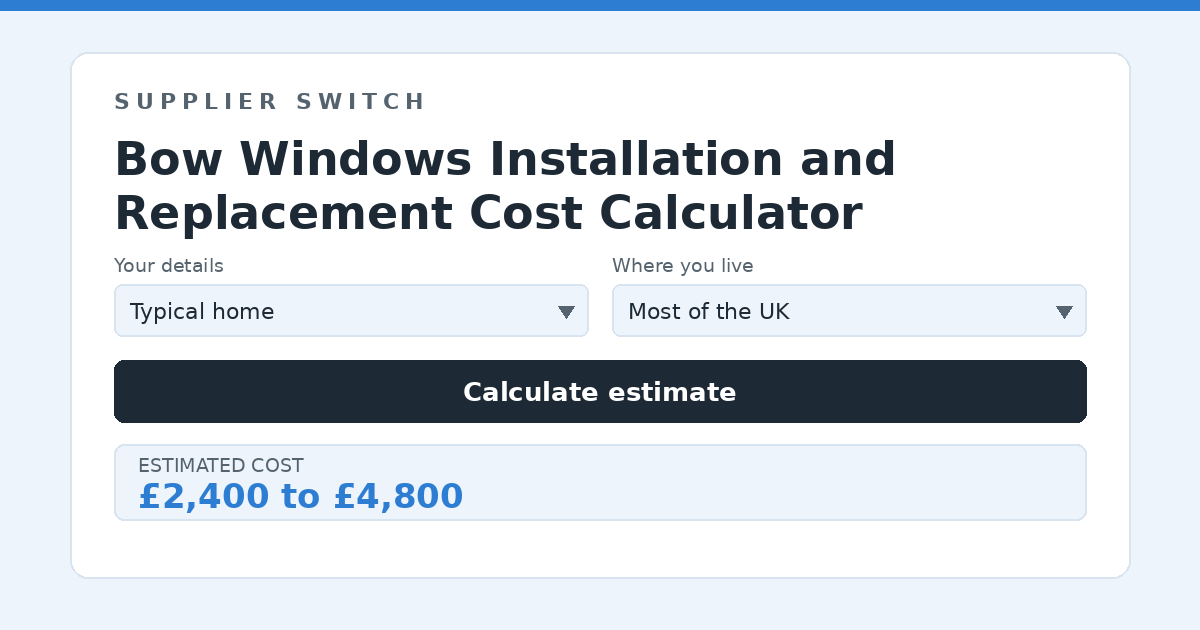
Estimate the cost of installing or replacing bow windows. A bow uses four or more panels set at gentle angles to form a smooth curve, and typically costs 40 to 60 percent more than an equivalent bay.
Estimated total cost range
All figures are indicative supply-and-fit ranges based on published UK cost guides. Real quotes vary with site conditions, access and specification – see the explainer and disclaimer below.
How this calculator works
This calculator estimates a realistic price range rather than a single figure, because real-world quotes genuinely vary that much. It starts from typical UK supplied-and-fitted price ranges drawn from published 2026 industry cost guides, then multiplies them by the number of units you enter and by adjustment factors for each choice you make below. The result is a low-to-high band that a fair quote is likely to fall within, not a promise of the exact price you will pay.
Bow windows typically cost around to fitted in uPVC in 2026, roughly 40 to 60 percent more than an equivalent bay window, because each curved run needs more panels and more complex manufacturing. Aluminium bows cost roughly 30 percent more than uPVC and timber roughly 50 percent more.
Number of bow windows
Enter how many bow windows you are pricing up. Bows are usually a single statement feature on the front elevation, though some properties pair a ground floor bow with a matching first floor unit.
Number of panels
Bow windows are built from multiple narrow panels, each set at a slightly different angle to create the curve. Every additional panel adds frame material, glass and installation time. Published price guides put a 4-panel uPVC bow at around to for the windows alone, with 5-panel designs at or more before installation.
Frame material
Frame material has a bigger effect on price than almost any other choice. uPVC is the baseline and accounts for around three quarters of UK installations. Aluminium typically costs 1.5 to 2 times as much as uPVC for the same opening, in exchange for slimmer sightlines and a longer lifespan. Timber usually costs around twice as much as uPVC and suits period properties, but needs repainting every five to eight years. Composite frames, with a timber core and aluminium outer skin, sit at the top of the market.
Specification level
Two windows that look similar from the street can sit at very different price points. Budget products use simpler profiles, standard hardware and basic glass. Mid-range covers the typical A-rated units most UK installers quote by default. Premium covers high-end systems with upgraded security hardware, better thermal performance, special finishes or designer profiles, and typically adds around 30 percent to the price.
Where you live
Labour rates are not uniform across the UK. Published cost guides consistently show installation prices in London and the South East running roughly 20 to 30 percent above the national average, driven by higher labour costs, travel, parking and congestion charges. The calculator applies an uplift of around 20 percent if you select London and the South East. Product prices themselves are broadly similar nationwide, so the difference mostly reflects fitting costs.
What else affects the price
The curve is what you pay for with a bow window: more panels, more joints to seal and more precise setting out during installation. Bow windows project further from the wall than most bays, which creates more internal space and better light but can also mean a larger roof section over the window and more flashing work. As with bays, replacing an existing bow is far cheaper than forming a new opening, and any structural changes bring building control into scope. Getting several like-for-like quotes matters even more than usual here, because bow pricing varies widely between installers.
Planning permission, building regulations and certification
Like-for-like window replacement on most houses does not need planning permission, but listed buildings always require consent and conservation areas often restrict materials and styles on visible elevations, so check with your local planning authority if either applies. Building regulations apply to every replacement window in a dwelling, setting minimum energy performance and safety glazing standards. Installers registered with a competent person scheme, such as FENSA or Certass, can self-certify compliance and issue a certificate after completion; otherwise you must arrange building control sign-off separately. Keep the certificate safe, as buyers’ solicitors routinely ask for it when you sell.
Sources
The typical price ranges and guidance used by this calculator draw on the following published resources, which are good starting points for further research: